
Chronic muscle pain that won’t go away, even after rest, massage, or painkillers? You might not have a pinched nerve or a herniated disc-you could be dealing with myofascial pain syndrome. This condition doesn’t show up on X-rays or MRIs, but it’s one of the most common causes of persistent pain in the neck, shoulders, back, and jaw. It’s not fibromyalgia. It’s not arthritis. It’s trigger points-tight, knotted bands in your muscles that send pain signals far from where they live.
What Exactly Are Trigger Points?
Trigger points are small, hypersensitive spots inside a taut band of muscle. Think of them like tiny electrical short circuits in your muscle fibers. They’re not visible, but you can feel them: a hard, rope-like knot under your skin that hurts when pressed. These aren’t just sore spots-they refer pain. Press one in your upper trapezius (the muscle that runs from your neck to your shoulder), and you might feel pain radiating to your temple, ear, or even your hand. That’s why so many people get misdiagnosed with migraines, carpal tunnel, or nerve compression. According to clinical studies, active trigger points are responsible for 85% of musculoskeletal pain complaints in pain clinics. The most common ones show up in the upper trapezius (65% of cases), levator scapulae (45%), and temporalis (35%). These muscles get overloaded from poor posture, stress, or repetitive movements. If you sit at a desk all day with your head jutted forward, your trapezius is constantly working overtime. Over time, it develops trigger points that don’t go away on their own. Trigger points aren’t just painful-they’re biochemically chaotic. Inside them, you’ll find 10 to 100 times more acetylcholine than normal muscle tissue. That’s the chemical that tells muscles to contract. Add in low pH (like vinegar levels), excess serotonin, and poor blood flow, and you’ve got a tiny zone of constant contraction. This squeezes nearby blood vessels, starving the muscle of oxygen and creating a cycle: pain → spasm → more pain.Differentiating Trigger Points from Tender Points
Many people confuse trigger points with tender points-especially because fibromyalgia is often mentioned alongside myofascial pain. But they’re completely different. Tender points, seen in fibromyalgia, are soft spots that hurt only when pressed. They’re symmetrical, usually found near joints, and don’t cause pain anywhere else. Trigger points? They’re hard, deep knots in muscle bellies. Press one, and you’ll feel pain travel-sometimes inches, sometimes across your body. A trigger point in your neck might make your wrist ache. One in your jaw can mimic a toothache. The difference matters because treatments vary. Fibromyalgia needs whole-body approaches-sleep, stress reduction, gentle movement. Myofascial pain syndrome responds to targeted release. If you’ve tried yoga, meditation, or supplements for your pain and nothing stuck, it might be trigger points you’re missing.How Trigger Points Form: The Real Causes
It’s not just “bad posture.” Trigger points form from specific, measurable stressors:- Acute injury: Whiplash from a car accident leads to MPS in 50-70% of cases within weeks.
- Chronic strain: Forward head posture increases trapezius trigger points by 3-5 times.
- Structural imbalance: A leg length difference over 1 cm raises your risk by 40%.
- Nutritional gaps: Vitamin D levels below 20 ng/mL correlate with 60% higher MPS incidence.
- Hormonal issues: Hypothyroidism is found in 15-25% of chronic MPS patients.
Trigger Point Release Techniques That Actually Work
There’s no single magic fix, but several techniques have solid evidence behind them. Here’s what works:1. Ischemic Compression
This is the most accessible method. You press directly on the trigger point with your thumb, knuckle, or a tool like a tennis ball or foam roller. Hold for 30 to 90 seconds until the pain eases by about 50%. Don’t push through sharp pain-aim for a “good hurt,” like a deep stretch. Repeat 3-5 times per session, once or twice daily. Studies show this technique gives 60-75% short-term relief. It works because sustained pressure temporarily cuts off blood flow, then releases it, flushing out pain-causing chemicals. It’s free, safe, and can be done at home.2. Dry Needling
This isn’t acupuncture. Dry needling uses thin, solid needles (like acupuncture needles) to pierce the trigger point. When the needle hits the knot, you often get a local twitch response-a quick, involuntary muscle spasm. That twitch is a good sign. It means the muscle fiber is resetting. Meta-analyses show dry needling reduces pain by 65-80% for 4-12 weeks. It’s especially effective for deep muscles like the piriformis or quadratus lumborum. You need a trained professional-physical therapist, chiropractor, or doctor with certification. Don’t let just anyone poke you with a needle.3. Trigger Point Injections
A doctor injects a small amount of lidocaine (a numbing agent) directly into the trigger point. This breaks the pain-spasm cycle instantly. Studies show 70-85% immediate pain reduction. The effect lasts 2-8 weeks. Some people get relief from saline injections alone, suggesting the physical act of penetrating the knot may be as important as the drug. Cochrane Review says there’s no significant difference between lidocaine injections and dry needling at 4 weeks. So if you’re not a fan of needles, dry needling is just as effective.4. Spray and Stretch
This technique uses a cold spray (like ethyl chloride) on the skin over the area where pain is referred. Then, the muscle is gently stretched. The cold numbs the skin and interrupts the pain signal, allowing the muscle to relax longer during the stretch. It’s especially useful for neck and shoulder pain. Many physical therapists use this before manual therapy.5. Instrument-Assisted Soft Tissue Mobilization (IASTM)
Tools like Graston or Gua Sha are scraped gently over tight muscle areas. It’s not painful if done right. It helps break up adhesions and stimulate blood flow. Studies show 55-70% effectiveness, especially when combined with stretching.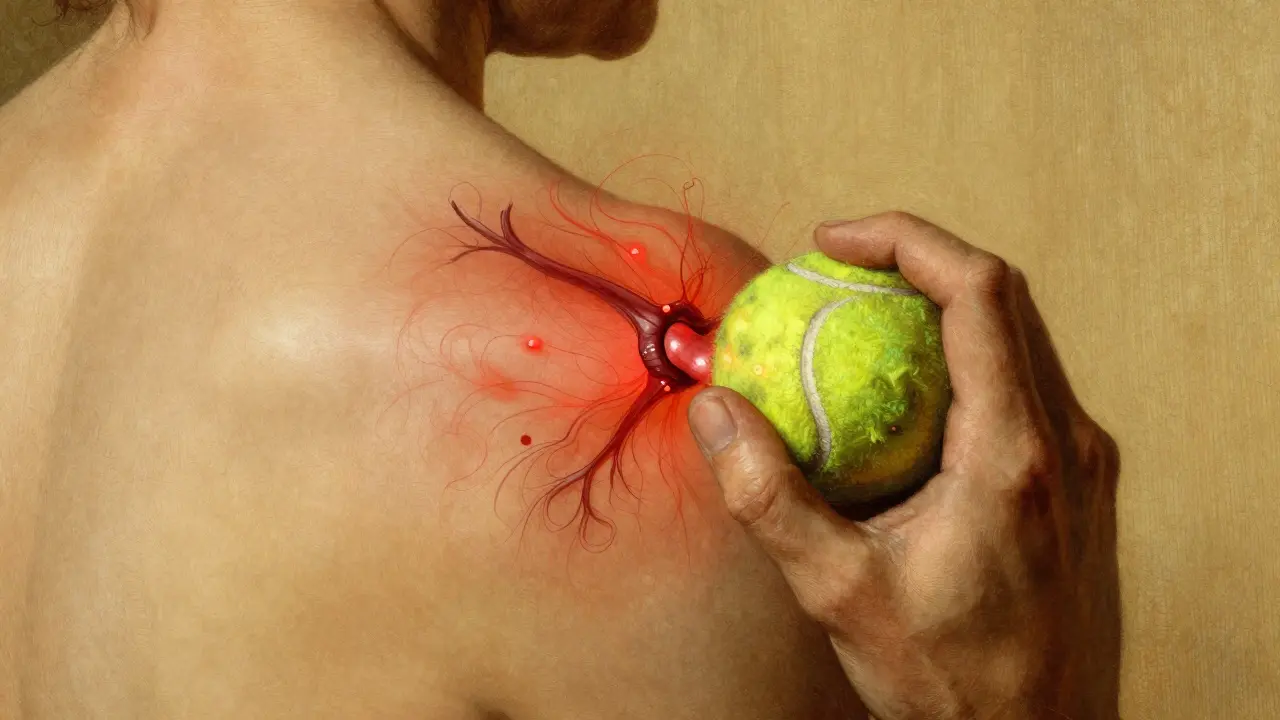
What Doesn’t Work (And Why)
Not every “myofascial release” technique is backed by science.- Regular massage: General relaxation massage rarely reaches deep enough to affect trigger points. You need focused pressure.
- Heat alone: Heat feels good, but it doesn’t release knots. Use heat before stretching or compression to loosen tissue, not as a standalone fix.
- Overstretching: Yanking on a muscle with a trigger point can make it worse. Stretch gently, only to mild tension.
- Untrained practitioners: A 2019 study found 32% of patients got worse after treatment from providers without proper trigger point training.
Home Management: The Key to Long-Term Relief
The biggest mistake people make? Treating trigger points like a one-time fix. They feel better after a session, then go back to slouching, stressing, or sleeping wrong. Pain comes back. Real relief requires daily habits:- Self-compression: Use a tennis ball against a wall or floor. Roll over tight areas for 5-10 minutes, twice a day.
- Posture correction: Set reminders to check your head position every hour. Keep ears over shoulders.
- Heat + stretch routine: Apply heat (40-45°C) for 15 minutes before stretching. Hold each stretch 30 seconds, repeat 3 times.
- Supplements: Magnesium glycinate (400 mg daily) helps relax muscle fibers. Vitamin D (if levels are low) is critical.
Why So Many People Are Misdiagnosed
Myofascial pain syndrome is invisible. No scan shows it. Doctors often order MRIs or nerve conduction tests first. By the time they consider trigger points, months have passed. One study found 57% of early MPS cases were misdiagnosed as nerve issues. Dr. Garry W.K. Ho from OrthoVirginia says, “You can get nerve symptoms along with trigger points too.” That’s why people think they have sciatica or carpal tunnel when it’s just a knot in their glute or forearm. If you’ve had persistent pain for more than 3 months, and imaging came back normal, ask your provider: “Could this be trigger points?” Bring a list of your symptoms and where the pain travels. Show them the classic referral patterns from Travell and Simons’ manuals.
When to Seek Professional Help
You can do a lot at home-but see a specialist if:- Pain lasts longer than 6 weeks despite self-care
- It’s interfering with sleep or daily tasks
- You’re getting numbness, tingling, or weakness
- Trigger points keep coming back in the same spot







Written by Martha Elena
I'm a pharmaceutical research writer focused on drug safety and pharmacology. I support formulary and pharmacovigilance teams with literature reviews and real‑world evidence analyses. In my off-hours, I write evidence-based articles on medication use, disease management, and dietary supplements. My goal is to turn complex research into clear, practical insights for everyday readers.
All posts: Martha Elena