
Drug Desensitization Protocol Estimator
Estimated Timeline
⚠️ MEDICAL DISCLAIMER: This is an educational estimation tool based on the provided article. Desensitization must ONLY be performed by board-certified specialists in a clinical setting equipped for anaphylaxis management.
Select a protocol and click calculate to view the estimated timeline.
Imagine being told you need a specific antibiotic to save your limb or a certain chemotherapy drug to fight a tumor, but your body reacts violently to it. For most of us, a medication allergy means "don't take this drug ever again." But what happens when that drug is the only one that works? This is where Desensitization Protocols is a medical process that induces temporary clinical unresponsiveness to drug antigens, allowing patients with severe hypersensitivity to safely receive essential medications. It isn't a permanent cure for an allergy, but rather a way to "trick" the immune system into accepting a drug it would otherwise attack.
When Is Desensitization Actually Necessary?
Doctors don't use desensitization as a first resort. If a patient is allergic to a drug, the easiest path is usually to find a different medication in the same class or a completely different one. However, there are scenarios where substitution simply doesn't work. For instance, in antibiotic treatment, swapping one penicillin for a cephalosporin often fails because of cross-reactivity-about 15-20% of cases see the same allergic reaction despite the change.
Desensitization becomes the standard of care when no therapeutic alternatives exist or when the drug in question is significantly more effective than any substitute. This is common in oncology, where a specific monoclonal antibody might be the only option to stop a cancer's growth, or in severe infections like osteomyelitis where a specific penicillin is the gold standard. In these cases, the benefit of the drug outweighs the risk of a reaction, provided the process is handled by specialists.
Rapid vs. Slow Desensitization: How It Works
Not all reactions are the same, so the protocols aren't either. The medical community generally splits these into two main categories based on how the body reacts.
Rapid Drug Desensitization (RDD) is used for immediate hypersensitivity reactions, which are typically IgE-mediated. This means the reaction happens almost instantly. The goal is to saturate the mast cells and basophils so they can't release a massive amount of histamine all at once. The process usually involves starting with a tiny fraction of the dose-sometimes as small as 1/10,000th of the full amount-and doubling it every 15 to 30 minutes. At Brigham and Women's Hospital, a common reference standard, they might administer 12 incremental doses over 4 to 6 hours until the full therapeutic dose is reached.
Slow Drug Desensitization (SDD) is reserved for type IV delayed hypersensitivity reactions. These aren't instant; they involve T cells and can take days to appear. Because these reactions are slower, the dosing intervals are much longer. While RDD happens in hours, SDD can take several days. This is the typical route for those needing Aspirin or other NSAIDs, where doses are increased slowly over a period of 2 to 3 days.
| Feature | Rapid Desensitization (RDD) | Slow Desensitization (SDD) |
|---|---|---|
| Reaction Type | Immediate (IgE-mediated) | Delayed (T cell-mediated) |
| Typical Duration | 4-6 Hours | 2-3 Days |
| Common Drugs | Penicillins, Monoclonal Antibodies | Aspirin, NSAIDs |
| Dosing Interval | 15-30 Minutes | Hours to Days |
| Success Rate | 95-100% | ~75% (Early trials) |
The Risks and the "Safety Net"
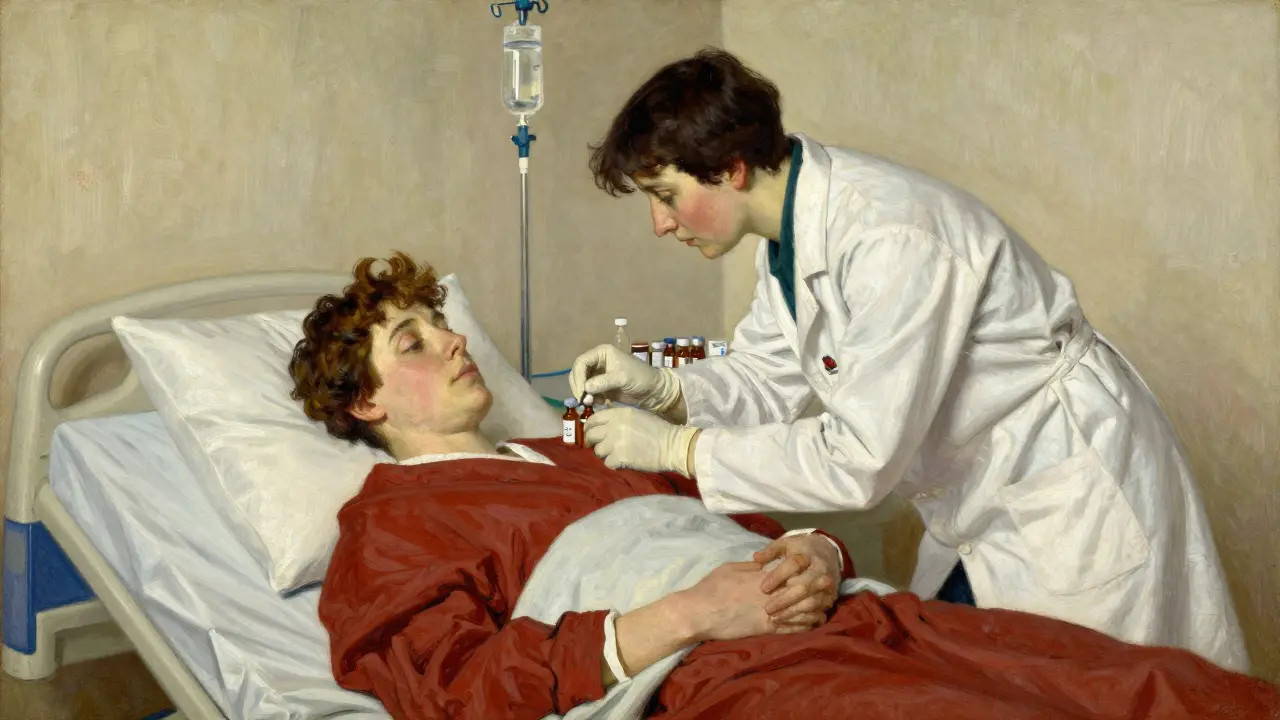
Let's be clear: this is a high-risk intervention. You don't do this at home or in a general clinic. Because you are intentionally giving someone a drug they are allergic to, the risk of anaphylaxis is real. This is why the American Academy of Allergy, Asthma & Immunology (AAAAI) provides strict guidelines. These procedures must happen in a facility equipped to handle a full-scale respiratory emergency.
Monitoring is intense. A patient isn't just sitting in a chair; they are under continuous surveillance. This includes blood pressure monitoring, pulse oximetry, and respiratory function tests at every single dose increment. Specialists like allergists and immunologists must lead the process, supported by nursing staff. In academic centers, this can require over four hours of nursing care per patient.
However, when done correctly, the safety profile is impressive. One study showed that for penicillin desensitization, 98% of patients succeeded with only mild side effects like flushing or itching, and zero deaths. The danger spikes when non-specialists attempt these protocols in community settings without the proper equipment, where complication rates can be three times higher.
Critical Contraindications: When to Say No
Desensitization is a powerful tool, but it is not a universal fix. There are some reactions that are simply too dangerous to risk. The biggest red flag is severe cutaneous adverse reactions. If a patient has a history of Stevens-Johnson Syndrome (SJS) or Toxic Epidermal Necrolysis (TEN), desensitization is strictly contraindicated. These conditions involve the skin peeling off in sheets and can be fatal; triggering this again via a desensitization protocol is an unacceptable risk.
Additionally, while IgE-mediated reactions have nearly a 100% success rate, severe delayed hypersensitivity reactions are trickier. About 30-40% of these cases fail, meaning doctors must be very selective about who they attempt to desensitize for T-cell mediated responses.
Why This Matters Now More Than Ever
You might wonder why we don't just keep inventing new drugs to avoid these allergies. The reality is that Antimicrobial Resistance is making that harder. As bacteria evolve, the number of effective antibiotics shrinks. We can't afford to lose the most effective drug just because a patient has a manageable allergy. This pressure is pushing more hospitals to adopt these protocols.
In the world of cancer treatment, the stakes are even higher. Many new-generation chemotherapy drugs have high rates of hypersensitivity. For many oncology patients, desensitization is literally life-saving because the "alternative" drug is either non-existent or far less effective at shrinking the tumor.
The Future: Precision Desensitization
We are moving away from a one-size-fits-all approach. The next frontier is biomarker-guided desensitization. Instead of guessing if a protocol will work, doctors are starting to use tools like basophil activation tests to predict success with nearly 89% accuracy. This takes the guesswork out of the process and makes it safer for the patient.
Within a few years, genetic and immunologic profiling will likely determine exactly which protocol a patient needs and how their body will respond. We may even see home-based protocols for stable patients who have already proven they can tolerate the drug, though this is still in the trial phase.
Is desensitization a permanent cure for a drug allergy?
No, it is not. Desensitization induces a temporary state of tolerance. This means it only works for the current course of treatment. If you stop taking the medication for a while and then need it again later, you will likely need to undergo the desensitization process all over again.
How long does a typical rapid desensitization take?
A typical rapid desensitization protocol for intravenous medications, such as antibiotics, usually takes between 4 to 6 hours. This involves multiple small doses given at 15-to-30-minute intervals until the full dose is reached.
Can I do drug desensitization at home?
Absolutely not. Desensitization involves intentionally administering a drug that has previously caused a severe reaction. Because of the risk of anaphylaxis, it must be performed in a clinical setting under the direct supervision of an allergist or immunologist with full emergency resuscitation equipment available.
What are the most common side effects during the process?
Most patients experience only mild reactions. The most common are pruritus (itching), flushing of the skin, or mild hives. Severe reactions are rare (less than 2%) when the protocol is administered by trained specialists in a proper facility.
Who is not a candidate for desensitization?
Patients who have experienced severe delayed cutaneous reactions, such as Stevens-Johnson Syndrome (SJS) or Toxic Epidermal Necrolysis (TEN), are not candidates. These conditions are too dangerous to risk triggering again. Additionally, some patients with severe T-cell mediated responses may not respond well to the process.
Next Steps for Patients and Caregivers
If you or a loved one are facing a situation where a necessary drug is contraindicated due to an allergy, your first step is to ask for a referral to a board-certified allergist or immunologist. Do not rely on a general practitioner's a-priori knowledge of allergies; a specialist can perform a proper skin test or a graded challenge to see if desensitization is a viable option.
If you are scheduled for a procedure, ensure it is taking place at an academic medical center or a facility with a dedicated allergy unit. Ask about the specific protocol they use (e.g., if they follow the Brigham and Women's standardized rapid protocol) and confirm that they have the necessary monitoring equipment, including pulse oximetry and emergency epinephrine, ready at the bedside.



Written by Martha Elena
I'm a pharmaceutical research writer focused on drug safety and pharmacology. I support formulary and pharmacovigilance teams with literature reviews and real‑world evidence analyses. In my off-hours, I write evidence-based articles on medication use, disease management, and dietary supplements. My goal is to turn complex research into clear, practical insights for everyday readers.
All posts: Martha Elena