
When you pick up a generic pill at the pharmacy, you expect it to work just like the brand-name version. But how does the FDA make sure it actually does? The answer lies in bioequivalence-a scientific standard that bridges the gap between brand-name drugs and their cheaper copies. It’s not about matching ingredients exactly. It’s about proving the body absorbs and uses them in the same way.
What Bioequivalence Really Means
Bioequivalence isn’t about whether two pills look the same or have the same color. It’s about what happens inside your body after you swallow them. The FDA defines it as the absence of a significant difference in how quickly and how much of the active drug reaches your bloodstream-and where it goes once it’s there. In simple terms: if you take a generic version of a drug, your body should process it just like the original brand.
This isn’t guesswork. It’s measured using real data from clinical studies. Researchers give a group of healthy volunteers the brand-name drug first, then later give them the generic version. Blood samples are taken over time to track how high the drug’s concentration goes (Cmax) and how long it stays in the system (AUC). These numbers tell the story.
The 80% to 125% Rule-What It Actually Covers
You might hear people say generic drugs can be 20% weaker or 25% stronger than the brand. That’s a myth. The 80% to 125% range doesn’t apply to the amount of active ingredient in the pill. It applies to the pharmacokinetic results-how your body handles the drug after it’s taken.
The FDA requires that the 90% confidence interval of the ratio between the generic and brand-name drug must fall entirely within 80% to 125% for both Cmax and AUC. That means if the brand’s average AUC is 100 units, the generic’s average must be between 80 and 125 units. But it’s not enough for the average to be in range-the whole range of possible values (the confidence interval) must be inside those bounds.
For example: if the generic drug shows an average AUC of 93 units, and the 90% confidence interval is 84 to 110, that’s approved. But if the average is 116 with a confidence interval of 103 to 130, it fails-even though the average is within range-because the upper limit (130%) goes beyond 125%.
This tight standard ensures that even in the worst-case scenario within the study population, the drug’s behavior stays predictable. It’s not a tolerance band for manufacturing errors. It’s a safety net for clinical outcomes.
Pharmaceutical Equivalence Comes First
Before bioequivalence is even tested, the generic must meet pharmaceutical equivalence. That means:
- Same active ingredient
- Same strength and dosage form (tablet, capsule, injection, etc.)
- Same route of administration (oral, topical, etc.)
- Same labeling and quality standards
If two drugs aren’t pharmaceutically equivalent, bioequivalence testing doesn’t matter. You can’t prove two things behave the same way if they’re not the same to begin with. This step filters out obvious mismatches before expensive clinical trials even start.
Why Healthy Volunteers? Not Patients
You might wonder why bioequivalence studies use healthy people instead of patients with the disease. The reason is simple: scientists want to isolate how the drug behaves in the body without interference from illness, other medications, or organ damage.
Healthy volunteers have predictable metabolism and kidney/liver function. That gives clean data. If a generic drug behaves differently in a healthy person, it’s unlikely to work the same in someone with liver disease or kidney failure. But if it passes in healthy people, it’s very likely to be safe and effective in patients too.
Studies typically involve 24 to 36 volunteers. They’re randomized, blinded, and given the drugs in a crossover design-meaning each person gets both the brand and the generic, at different times, with a washout period in between. This removes individual differences from the equation.

When Bioequivalence Isn’t Enough
Not all drugs need blood tests. Some work right where they’re applied-like eye drops, inhalers, or topical creams. For those, the FDA allows in vitro testing. That means lab tests on the drug’s physical properties: how fast it dissolves, how evenly it spreads, how stable it is.
For example, a generic asthma inhaler doesn’t need blood samples. Instead, scientists test how much drug comes out per puff, how fine the mist is, and how well it sticks to the lungs. If those match the brand, the FDA accepts it as equivalent.
But for drugs meant to enter the bloodstream-like antibiotics, antidepressants, or blood thinners-in vivo testing is required. You can’t fake what your body does with a drug once it’s absorbed.
What About Narrow Therapeutic Index Drugs?
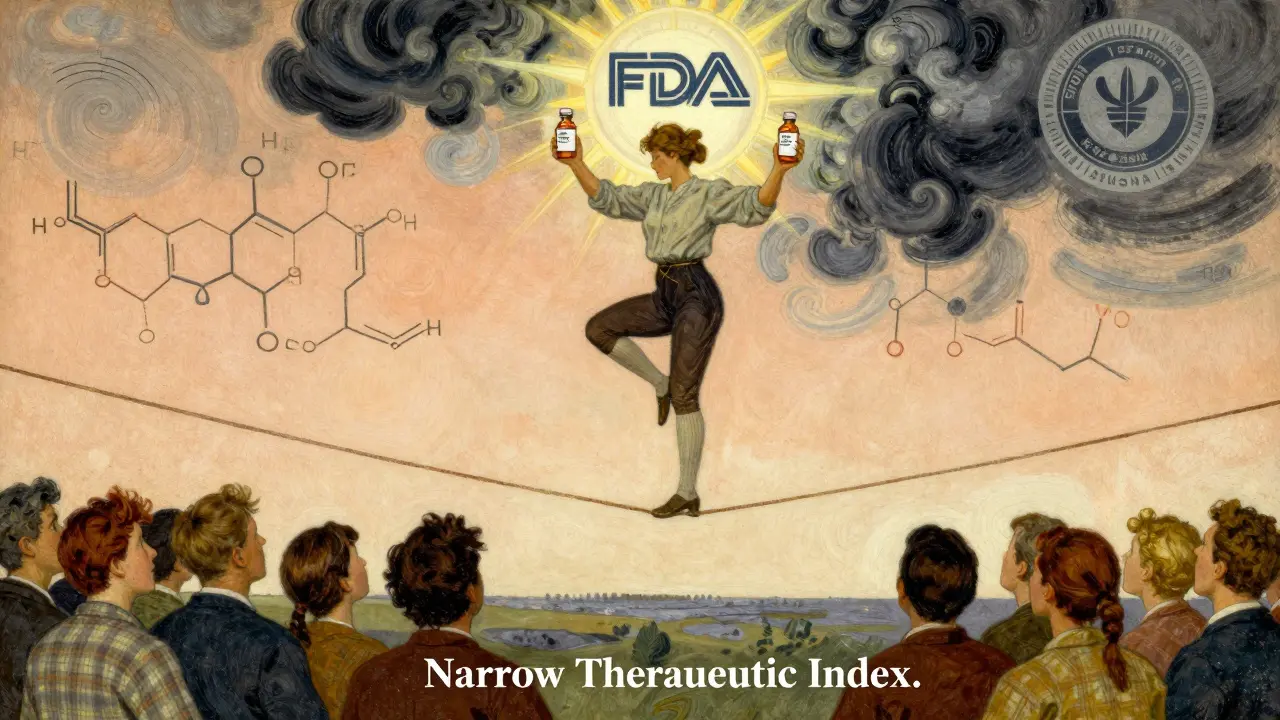
Some drugs are like walking a tightrope. Too little won’t work. Too much can kill you. Examples include warfarin, lithium, phenytoin, and levothyroxine. These are called narrow therapeutic index (NTI) drugs.
People often assume these need stricter bioequivalence rules. But the FDA still uses the same 80%-125% range. Why? Because decades of real-world data show that when generics pass the standard test, they perform just as safely as brands in clinical use.
That doesn’t mean doctors don’t watch closely. Many still prefer to stick with one brand for NTI drugs, especially when switching patients. But that’s a clinical choice, not a regulatory one. The science says generics are safe. The caution comes from habit, not evidence.
Transparency and the New Rules
Until recently, drug companies only had to submit bioequivalence studies that worked. If a study failed, they could just tweak the formula and try again-without telling the FDA.
Since 2021, the FDA requires all bioequivalence studies to be submitted, even the failed ones. This change was made to stop companies from cherry-picking results and to give regulators a clearer picture of how hard it was to get the formula right.
It also helps other manufacturers. If a company sees that a certain formulation kept failing bioequivalence, they can avoid the same mistakes. That speeds up the whole approval process and reduces wasted effort.
How Many Generics Actually Get Approved?
The FDA reviews about 1,000 generic drug applications every year. About 65% get approved on the first try. The rest get rejected-not because the drug doesn’t work, but because of issues with the study design, formulation, or data reporting.
The most common reason for rejection? Bioequivalence studies that don’t meet the 80%-125% confidence interval. Sometimes it’s because the generic dissolves too slowly. Other times, it’s because of batch-to-batch variation in manufacturing.
Companies often go back, adjust the excipients (inactive ingredients), change the coating, or tweak the manufacturing process. Then they try again. It’s expensive, but it’s worth it. Once approved, a generic drug can capture over 80% of the market within a year.
Why This Matters to You
Generic drugs make up 90% of prescriptions in the U.S. But they cost only 20% of what brand-name drugs do. Over the past decade, they saved the healthcare system more than $1.7 trillion.
That’s not just a number. It’s a parent choosing between buying insulin or groceries. It’s an elderly person skipping a dose because the brand is too expensive. It’s a chronic illness patient who can finally stick to their treatment plan.
Bioequivalence is the invisible guarantee behind every generic pill you take. It’s not magic. It’s science. And it’s the reason you can trust that $4 generic is just as safe and effective as the $400 brand.
What’s Next for Bioequivalence?
The FDA is working on new tools to make bioequivalence testing faster and smarter. For complex products-like patches, inhalers, or long-acting injectables-traditional methods don’t always work. So the agency is exploring modeling and simulation. These computer models predict how a drug will behave in the body based on its physical and chemical properties.
If proven reliable, this could cut down on human trials for certain drugs. That means faster approvals, lower costs, and more access to generics-especially for hard-to-make medications.
Right now, only about 10% of generic approvals are for complex products. But that number is growing. By 2025, experts predict it could jump to 20% annually as these new methods become standard.
One thing won’t change: the FDA’s commitment to safety. No matter how the science evolves, the goal stays the same-make sure every generic drug you take works just like the brand.
Are generic drugs really as effective as brand-name drugs?
Yes. The FDA requires generics to meet strict bioequivalence standards, meaning they deliver the same amount of active ingredient into the bloodstream at the same rate as the brand-name version. Thousands of studies and decades of real-world use confirm that generics work just as well.
Can a generic drug have a different active ingredient than the brand?
No. By law, a generic drug must contain the exact same active ingredient, in the same strength and dosage form, as the brand-name drug. The only differences allowed are in inactive ingredients like fillers or dyes, which don’t affect how the drug works.
Why do some people say generics don’t work as well?
Sometimes it’s due to placebo effects or changes in pill appearance, which can make people feel like the drug isn’t working. Other times, it’s confusion between bioequivalence (how the body absorbs the drug) and the actual amount of active ingredient (which must be identical). There’s no scientific evidence that FDA-approved generics are less effective.
Does the FDA test every batch of generic drugs?
The FDA doesn’t test every single batch, but it inspects manufacturing facilities regularly and randomly tests products on the market. If a batch fails quality or bioequivalence standards, the FDA can pull it from shelves and halt production.
Why do some generics cost more than others?
Price differences come from competition, supply chain costs, and who manufactures the drug. When multiple companies make the same generic, prices drop. If only one company makes it, they may charge more. The FDA doesn’t set prices-only standards.







Written by Martha Elena
I'm a pharmaceutical research writer focused on drug safety and pharmacology. I support formulary and pharmacovigilance teams with literature reviews and real‑world evidence analyses. In my off-hours, I write evidence-based articles on medication use, disease management, and dietary supplements. My goal is to turn complex research into clear, practical insights for everyday readers.
All posts: Martha Elena