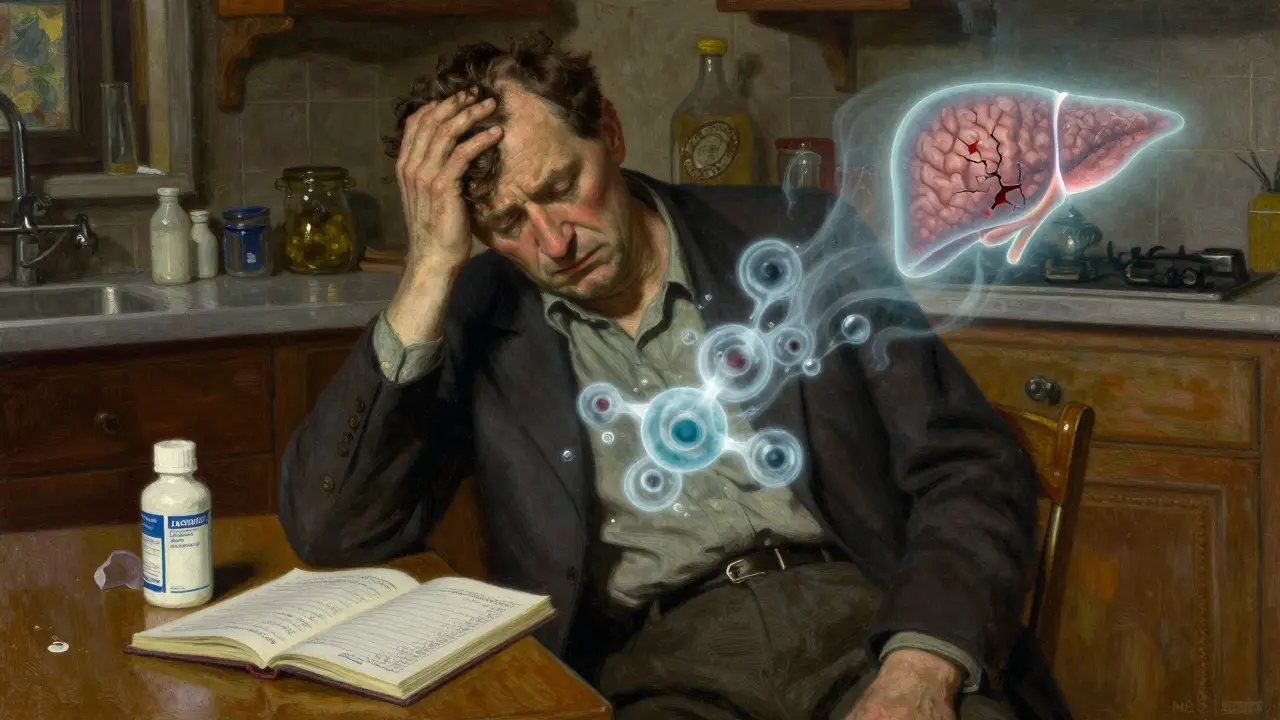
What Is Hepatic Encephalopathy?
When your liver can’t clean your blood properly, toxins-especially ammonia-build up and start affecting your brain. This is hepatic encephalopathy (HE). It’s not dementia. It’s not Alzheimer’s. It’s a reversible brain disorder caused by advanced liver disease, most often cirrhosis. People with HE might seem confused, forgetful, or even sleepy. Sometimes they talk incoherently or lose track of time. In severe cases, they slip into a coma. The good news? With the right treatment, many of these symptoms can improve-or even disappear.
HE doesn’t come out of nowhere. It usually happens when the liver is badly damaged and can’t process waste like ammonia. Instead of being filtered out, ammonia travels straight to the brain through abnormal blood vessels called shunts. Gut bacteria also play a big role: certain types produce ammonia from protein in your intestines. That’s why managing your gut health is just as important as treating your liver.
How Do You Know If You Have It?
HE doesn’t always scream for attention. Sometimes it whispers. In its mildest form-called minimal HE-you might just feel a little off. You take longer to do simple tasks. You forget why you walked into a room. You struggle to focus during conversations. These signs are easy to miss, even by doctors. Special tests like the EncephalApp Stroop test on a smartphone can catch it early.
When HE gets worse, it’s harder to ignore. You might sleep all day and stay awake at night. Your personality changes-you become irritable or withdrawn. You might write nonsense messages or mix up words. At the worst stage, you lose consciousness. Doctors classify these stages from Grade 1 (mild) to Grade 4 (coma). The higher the grade, the more urgent the treatment.
But here’s the catch: many people are misdiagnosed. A 2022 survey by the British Liver Trust found that 31% of HE patients were first told they had dementia. That’s why it’s critical to tell your doctor if you have liver disease-especially cirrhosis-and you’re feeling mentally foggy. Don’t assume it’s just aging.
Why Lactulose Is the First Line of Treatment
Lactulose has been the go-to treatment for HE since the 1960s. It’s not a miracle drug, but it’s proven. It’s cheap, widely available, and works for most people. How? It’s a sugar that doesn’t get absorbed in your stomach or small intestine. Instead, it travels to your colon, where gut bacteria break it down. This process makes your colon more acidic, which traps ammonia in the form of ammonium. Ammonium can’t cross into your bloodstream-it’s stuck in your gut and flushed out when you have a bowel movement.
The goal? Two to three soft stools a day. Too few, and ammonia builds up. Too many, and you’re in the bathroom constantly. That’s why dosing matters. Doctors usually start with 30-45 mL three or four times a day. If you don’t have a bowel movement within 24 hours, the dose is increased. Some people need rectal enemas if they’re too confused to take it orally.
But here’s the reality: 68% of patients say lactulose works-but 79% struggle with side effects. Diarrhea, cramps, bloating, and the awful taste make it hard to stick with. A Reddit user wrote: “Lactulose saved me from hospitalization, but the constant bathroom trips ruined my job interviews.” That’s why adherence is a huge problem. Studies show 65% of people who don’t respond to lactulose aren’t taking enough. They’re scared of the side effects and cut the dose. That’s dangerous.

What If Lactulose Isn’t Enough?
For people who keep having flare-ups, doctors add another drug: rifaximin. It’s an antibiotic that doesn’t get absorbed into your blood. It stays in your gut and kills the ammonia-producing bacteria. The RIFHE study showed it cuts recurrent HE episodes by 58% compared to placebo. It’s not cheap-about $1,200 a month-but for many, it’s life-changing. One patient on Hep Forums said: “After six months of lactulose and rifaximin, my cognitive test scores improved and I went back to part-time work.”
Other options exist too. L-ornithine-L-aspartate (LOLA) helps your liver process ammonia faster. It’s used more in Europe and Asia. Newer treatments like SYN-004 (a gut-protecting enzyme) and fecal microbiota transplants (FMT) are showing promise in trials. FMT, which transfers healthy gut bacteria from a donor, normalized ammonia levels in 70% of patients who didn’t respond to standard therapy.
But rifaximin isn’t perfect. There’s a small risk of C. diff infection, and resistance is starting to show up. A 2023 study found 8.7% of gut bacteria in HE patients were becoming resistant. That’s why researchers are testing non-antibiotic alternatives like L-norvaline, which is now in Phase 3 trials.
What Triggers a Flare-Up?
HE doesn’t just happen. Something pushes it over the edge. And knowing your triggers can prevent hospital visits. The top three culprits:
- Infections-especially spontaneous bacterial peritonitis (SBP), which causes 25-30% of HE episodes.
- Bleeding-from ulcers or varices in the esophagus or stomach. Blood in the gut turns into ammonia.
- Electrolyte imbalances-like low potassium or too many diuretics. These change how your body handles ammonia.
Other common triggers: constipation, dehydration, kidney problems, and certain medications like benzodiazepines (sleep aids or anxiety meds), which can increase HE risk by 3.2 times. One caregiver on Reddit noticed her husband’s HE flares always came after a UTI. She started testing him monthly-and cut his episodes by 80%.
That’s why regular check-ups aren’t optional. If you have cirrhosis, you need to be screened for infections, bleeding, and electrolytes-even if you feel fine.
How to Prevent Hepatic Encephalopathy
Prevention is cheaper, safer, and more effective than treating an episode. The American Association for the Study of Liver Diseases recommends prophylactic lactulose (15 mL twice daily) for anyone who’s had HE before. That reduces recurrence by 50% in six months.
Diet matters-but not the way you think. You don’t need to cut protein. In fact, too little protein can make you weaker and more prone to infections. The key is balance: during an active HE episode, limit protein to 0.5 grams per kilogram of body weight. Once you’re stable, go back to 1.2-1.5 grams per kilogram. That’s about 70-90 grams of protein a day for a 70 kg person-equivalent to two chicken breasts and a cup of lentils.
Avoid alcohol completely. Avoid sedatives. Get vaccinated for hepatitis A and B. Keep your gut moving-constipation is a silent trigger. Drink water. Take your lactulose regularly. Track your bowel movements. Use apps like EncephalApp to monitor your thinking skills at home.
And don’t wait for symptoms. If you have cirrhosis, ask your doctor about a HE prevention plan. It’s not just about pills. It’s about habits, monitoring, and knowing when to call for help.

What’s Next for Hepatic Encephalopathy?
The future of HE treatment is moving beyond ammonia. Scientists now see it as a gut-liver-brain axis problem. That means fixing the gut microbiome, not just lowering ammonia. The NIH is funding a $5.2 million project to develop a blood test that predicts HE risk with 85% accuracy using 12 biomarkers. Another study at Virginia Commonwealth University is testing smartphone apps that detect early cognitive changes-before patients even notice them.
And there’s hope: the FDA just approved a new combo pill called Xifaxilac, which combines lactulose and rifaximin in one tablet. In Europe, AST-120 (an oral adsorbent) is now approved for prevention. These aren’t cures, but they’re steps toward making HE manageable long-term.
The goal? Reduce hospitalizations, avoid coma, and let people live full lives. Right now, HE costs the U.S. $1.1 billion a year. But with proper prevention, hospitals could save $14,200 per patient annually. That’s not just money-it’s time, dignity, and independence.
Frequently Asked Questions
Can hepatic encephalopathy be cured?
Hepatic encephalopathy can be reversed with treatment, especially if caught early. But it won’t go away unless the underlying liver disease is treated. A liver transplant is the only cure for advanced cirrhosis. For most people, HE is a chronic condition that requires ongoing management with lactulose, diet, and avoiding triggers.
Is lactulose safe for long-term use?
Yes, lactulose is safe for long-term use. It’s not absorbed into the bloodstream, so it doesn’t affect other organs. The main issue is side effects-diarrhea, cramps, bloating-which can be managed by adjusting the dose. Most people learn to tolerate it over time. If you’re having trouble, talk to your doctor about switching to a flavored version or combining it with rifaximin to lower the dose.
Does ammonia testing help diagnose HE?
Blood ammonia levels are not reliable for diagnosing HE in chronic liver disease. Many patients with severe confusion have normal ammonia levels, and some with high ammonia show no symptoms. Doctors rely more on symptoms, liver function tests, and ruling out other causes like stroke or infection. Ammonia testing is more useful in acute liver failure, where levels often rise sharply.
Can I still eat meat if I have hepatic encephalopathy?
Yes, but you need to be smart about it. During an active episode, reduce protein to avoid feeding ammonia-producing bacteria. Once you’re stable, aim for 1.2-1.5 grams of protein per kilogram of body weight daily. Lean meats, eggs, dairy, and plant proteins like beans and tofu are fine. Avoid processed meats and excessive red meat. A dietitian can help you plan meals that protect your brain without making you weak.
How often should I get checked if I have cirrhosis?
If you have cirrhosis, you should see your liver specialist every 3-6 months. During these visits, they’ll check for signs of HE, screen for infections, test your electrolytes, and look for bleeding risks. Don’t wait for symptoms. Early detection saves lives. Ask for the EncephalApp test or a simple cognitive screening-it takes less than five minutes and can catch problems before they become emergencies.
What to Do Next
If you or someone you care about has cirrhosis and is showing signs of confusion, don’t wait. Call your doctor. Start tracking bowel movements. Write down when confusion happens-after meals? After antibiotics? After a missed dose of lactulose? Bring this log to your next appointment.
If you’re on lactulose and not having two to three soft stools a day, increase the dose. If you’re having too many, lower it. Don’t guess. Adjust based on results. Talk to your pharmacist about flavor options. Ask about rifaximin if you’ve had more than one flare-up in a year.
And if you’re a caregiver-pay attention. Family members notice changes 48-72 hours before doctors do. A subtle change in speech, a missed appointment, or forgetting a name isn’t just aging. It could be HE. Be the person who speaks up. You might be the reason someone avoids the ICU.







Written by Martha Elena
I'm a pharmaceutical research writer focused on drug safety and pharmacology. I support formulary and pharmacovigilance teams with literature reviews and real‑world evidence analyses. In my off-hours, I write evidence-based articles on medication use, disease management, and dietary supplements. My goal is to turn complex research into clear, practical insights for everyday readers.
All posts: Martha Elena