
When your thyroid goes off track, it doesn’t just make you tired-it rewires how your whole body works. One person gains weight, feels cold, and struggles to get out of bed. Another loses weight, can’t sit still, and feels like their heart is pounding even when they’re resting. These aren’t just different moods or bad days. They’re signs of two opposite thyroid conditions: hypothyroidism and hyperthyroidism. Both are common, often misunderstood, and easy to miss because their symptoms sneak up slowly. But knowing the difference can save you months-or years-of confusion and unnecessary suffering.
What’s Actually Happening in Your Body?
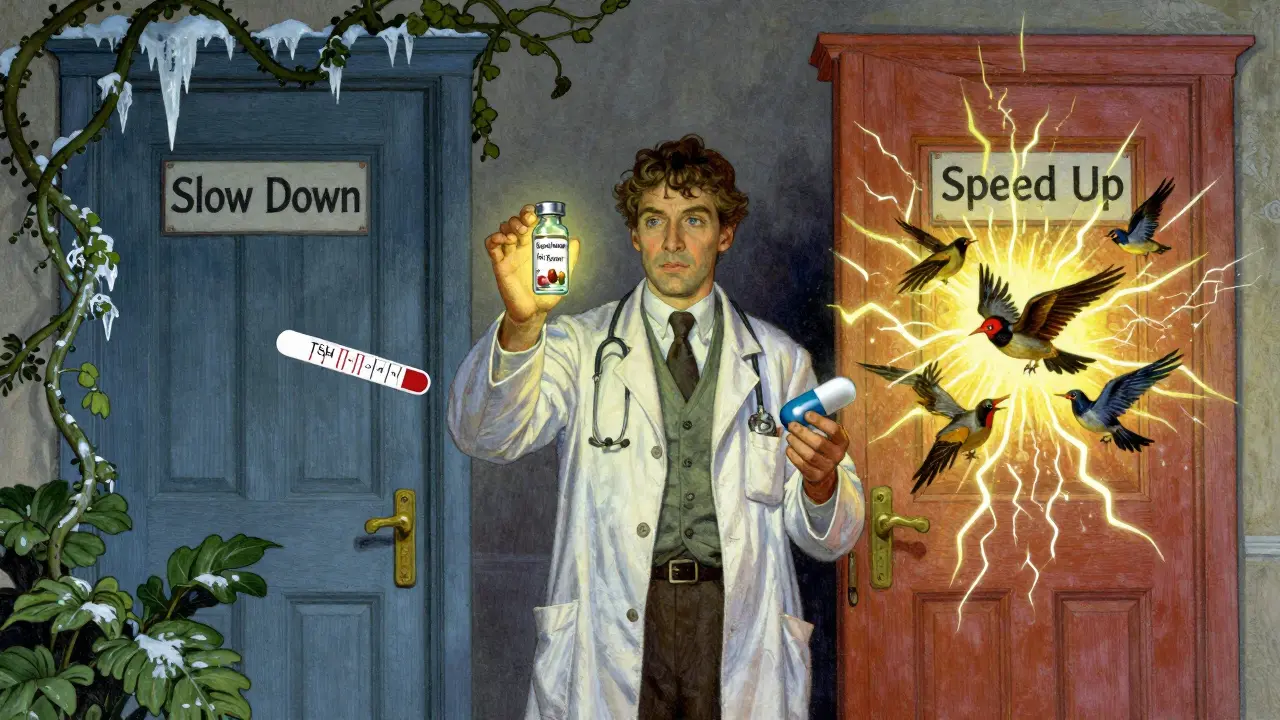
Your thyroid is a small butterfly-shaped gland at the base of your neck. It makes two hormones: T4 and T3. These hormones tell your cells how fast to burn energy. Think of them like a thermostat for your metabolism. If the thermostat is stuck too low, everything slows down-that’s hypothyroidism. If it’s stuck too high, everything speeds up-that’s hyperthyroidism.
The body keeps this balance using TSH, a signal from the pituitary gland. When thyroid hormone levels drop, TSH rises to tell the thyroid to work harder. When levels are too high, TSH drops to slow things down. So in hypothyroidism, TSH is high and T4 is low. In hyperthyroidism, TSH is low and T4 is high. That’s the lab test difference. But symptoms? They feel completely different.
How Hypothyroidism Feels
If you have hypothyroidism, your body feels like it’s running on batteries that are almost dead. You’re not lazy-you’re drained. Eighty-seven percent of people with this condition report being constantly cold, even in warm rooms. Your skin gets dry, your hair thins, and your nails become brittle. You might gain 10 to 30 pounds without changing what you eat. Constipation becomes normal. Your period gets heavier and more frequent.
Depression isn’t just sadness here-it’s a heavy fog. Forty-five percent of people with hypothyroidism say they feel hopeless, unmotivated, or emotionally flat. Brain fog is real: forgetting names, losing your train of thought, struggling to focus. One woman on a thyroid forum said, “I took my meds, my TSH was perfect, but I still couldn’t remember my kid’s teacher’s name. I felt broken.”
Heart rate drops below 60 beats per minute. You feel sluggish walking up stairs. Your voice gets hoarse. Even your reflexes slow down. These aren’t exaggerations. They’re measurable changes in how your cells use energy.
How Hyperthyroidism Feels
Hyperthyroidism is the opposite. It’s like your body’s engine is stuck in overdrive. Ninety-two percent of people with this condition have a heart rate over 100 bpm-even at rest. You might feel your heart fluttering or pounding. Anxiety isn’t just stress-it’s panic. Seventy-six percent report constant nervousness, trembling hands, or sudden fear without reason. You lose weight even if you’re eating more. Your bowels move faster-sometimes to the point of diarrhea.
Heat intolerance is extreme. You sweat through clothes in air-conditioned rooms. You can’t sleep because your body won’t shut down. Your eyes might bulge or feel gritty-especially if you have Graves’ disease, which causes about 70% of hyperthyroidism cases. Women often have lighter or skipped periods.
And here’s the twist: older adults don’t always show the classic signs. Up to 40% of people over 65 with hyperthyroidism don’t feel anxious or have a fast heartbeat. Instead, they feel depressed, weak, or confused-mimicking dementia. That’s why doctors miss it so often in seniors.
What Causes Each Condition?
Hypothyroidism is most often caused by Hashimoto’s thyroiditis-an autoimmune disease where your immune system attacks your thyroid. It’s like your body turns on itself. Ninety percent of cases in the U.S. come from this. Other causes include thyroid surgery, radiation treatment for cancer, or certain medications.
Hyperthyroidism is usually caused by Graves’ disease-another autoimmune condition, but this time your immune system overstimulates the thyroid. It’s the same kind of error, just the opposite direction. Toxic nodules or an enlarged thyroid with multiple overactive spots (toxic multinodular goiter) cause most of the rest.
Women are five to eight times more likely to get either condition. Why? Scientists think it’s tied to how X chromosomes regulate immune responses. That’s why you’ll see more women than men in thyroid clinics.
How Doctors Diagnose Them
You can’t diagnose either by symptoms alone. Too many things-stress, sleep deprivation, menopause-can mimic them. The only reliable way is a blood test.
First, check TSH. If it’s above 4.5 mIU/L, you likely have hypothyroidism. If it’s below 0.4 mIU/L, you likely have hyperthyroidism. Then, doctors check free T4 and sometimes free T3 to confirm. That’s it. No scans, no biopsies-unless something looks unusual.
Harvard Medical School warns against treating mild TSH elevations (between 5 and 10) if you have no symptoms. Up to 5 million Americans are unnecessarily put on thyroid pills every year because of this. Only treat if TSH is over 10, or if you have clear symptoms.
Treatment: One Is Simple. The Other Is Complicated.
Hypothyroidism treatment is straightforward: take a daily pill called levothyroxine. It replaces the T4 your thyroid can’t make. Dose? Around 1.6 micrograms per kilogram of body weight. For a 70kg person, that’s about 112 mcg per day. Most people feel better in 6 to 8 weeks. Ninety-five percent get their energy, weight, and mood back.
But here’s the catch: you have to take it right. On an empty stomach. At least 30 to 60 minutes before breakfast. Coffee, calcium, iron, or soy can block absorption. Forty-five percent of patients mess this up-and wonder why they still feel tired.
Hyperthyroidism has three main paths: drugs, radioactive iodine, or surgery.
Methimazole or propylthiouracil block hormone production. But they come with risks: liver damage (1 in 2,000) or low white blood cells (1 in 500). Monthly blood tests are required. These are usually tried first, especially in young people or pregnant women.
Radioactive iodine (I-131) is the most common long-term fix in the U.S. You swallow a capsule. The radiation destroys overactive thyroid cells. Within a year, 80% of people become hypothyroid. That sounds bad-but it’s actually good. Now you’re on a simple pill instead of juggling side effects and risky meds.
Surgery is rare, used only if the thyroid is huge, cancer is suspected, or meds don’t work. It’s permanent. You’ll need lifelong thyroid hormone replacement after.
What No One Tells You About Long-Term Management
Even when labs look normal, some people with hypothyroidism still feel awful. Why? About 15% of people have genetic differences that make it hard to convert T4 into active T3. Standard levothyroxine doesn’t fix that. Some doctors add T3 (liothyronine), but this isn’t mainstream yet. Research is ongoing.
For hyperthyroidism, the biggest issue is what happens after treatment. Most people end up hypothyroid. That means switching from one condition to another-and learning a whole new routine. Many patients say, “I thought curing hyperthyroidism would fix me. Instead, I just got a new problem.”
Pregnancy changes everything. Propylthiouracil is preferred in early pregnancy because methimazole can harm the baby. But it carries a rare risk of liver failure. Doctors have to balance risks carefully.

Why This Matters More Than You Think
Thyroid disorders cost the U.S. healthcare system billions. Untreated hypothyroidism leads to lost productivity-up to $2,500 per person per year. Hyperthyroidism treatment averages $3,500 to $6,000 annually. That’s why early testing matters.
Levothyroxine is the third most prescribed drug in the U.S. Over 114 million prescriptions were filled in 2022. That’s not because everyone needs it. It’s because so many people are undiagnosed-or misdiagnosed.
And here’s the hopeful part: once you get the right diagnosis and treatment, life gets back to normal. People who stick with their plan report sleeping better, losing weight, regaining focus, and feeling like themselves again. You don’t have to live with brain fog or panic attacks. There’s a solution.
What to Do If You Think You Have One
Start with a TSH test. Ask your doctor for it. It costs less than $50. No fasting needed. No needles beyond the blood draw.
If your TSH is abnormal, get free T4 tested too. Don’t stop there. If you’re still symptomatic and your TSH is normal, ask about free T3 and thyroid antibodies (TPO and TgAb). That can reveal hidden autoimmune issues.
Track your symptoms. Write down your energy levels, weight, mood, temperature sensitivity, and sleep. Bring it to your appointment. Doctors rely on labs-but your lived experience guides the treatment.
Don’t accept “it’s just stress” or “you’re getting older.” Thyroid problems are common, treatable, and often missed. If your doctor dismisses you, find one who listens. Endocrinologists specialize in this-but many primary care doctors know how to manage it well too.
Can hypothyroidism turn into hyperthyroidism?
No, one doesn’t turn into the other. But treatment for hyperthyroidism-especially radioactive iodine or surgery-often causes hypothyroidism. So you go from overactive to underactive, not the other way around. It’s a side effect of treatment, not a natural progression.
Can you have both hypothyroidism and hyperthyroidism at the same time?
Not really. Your thyroid can’t be both underactive and overactive at once. But some people with Hashimoto’s experience temporary hyperthyroidism during flare-ups, called hashitoxicosis. It’s rare and short-lived. True dual diagnosis isn’t possible.
Is thyroid medication safe for life?
Yes. Levothyroxine is a synthetic version of the hormone your body naturally makes. It’s one of the safest medications available. Millions take it for decades with no side effects when dosed correctly. The risk comes from too much or too little-not from the drug itself.
Why do some people still feel bad even with normal TSH?
About 15% of people have genetic variations that make it hard to convert T4 into active T3. Standard levothyroxine only replaces T4. If your body can’t turn it into T3, you’ll still feel tired or foggy. Testing free T3 and checking for TPO antibodies can help. Some patients benefit from adding T3, though this isn’t yet standard care.
Can diet cure thyroid conditions?
No. No diet, supplement, or cleanse can fix an underactive or overactive thyroid. Selenium and iodine play roles in thyroid function, but taking extra won’t help unless you’re deficient-and most people in developed countries aren’t. In fact, too much iodine can trigger hyperthyroidism in susceptible people. Medication is the only proven treatment.
How often do you need blood tests after starting treatment?
After starting levothyroxine, get tested every 6 to 8 weeks until your TSH is stable. Once stable, once a year is enough-unless you change dose, get pregnant, or feel symptoms return. For hyperthyroidism on methimazole, monthly tests are needed at first to watch for side effects. After that, every 2 to 3 months.
Next Steps If You’re Struggling
If you’ve been told your labs are fine but you still feel awful, ask for free T3 and thyroid antibody tests. Bring a symptom journal. Don’t settle for “it’s all in your head.”
If you’re newly diagnosed, learn how to take your pills correctly. No coffee, calcium, or iron for an hour after. Take them at the same time every day.
If you’ve had radioactive iodine and now feel tired again, don’t panic. You’re not failing. You’re just on the next step. Hypothyroidism after treatment is expected-and easily managed.
Thyroid conditions aren’t curable, but they’re controllable. You don’t need to live in fog or panic. With the right test, the right treatment, and the right doctor, you can feel like yourself again.







Written by Martha Elena
I'm a pharmaceutical research writer focused on drug safety and pharmacology. I support formulary and pharmacovigilance teams with literature reviews and real‑world evidence analyses. In my off-hours, I write evidence-based articles on medication use, disease management, and dietary supplements. My goal is to turn complex research into clear, practical insights for everyday readers.
All posts: Martha Elena