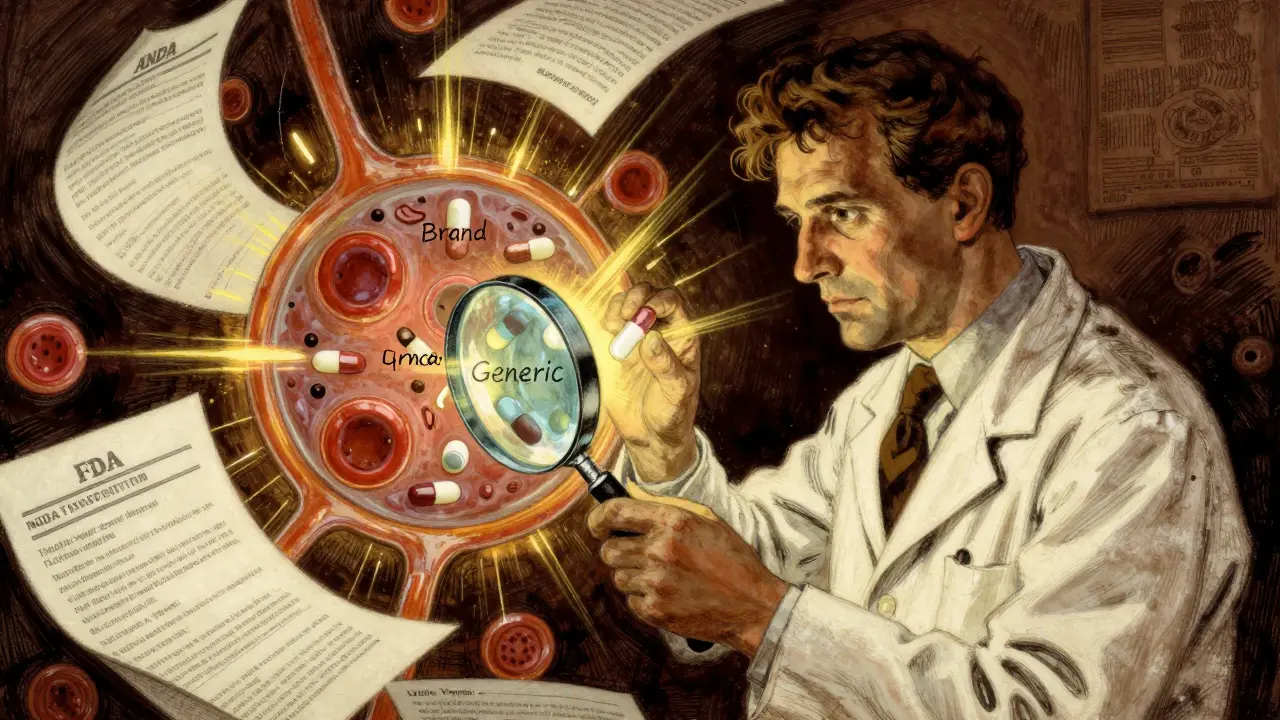
When you pick up a prescription and see a generic version on the shelf, you’re not just saving money-you’re relying on a system built by the FDA to ensure it’s just as safe and effective as the brand-name drug. But how does that actually work? The FDA doesn’t just approve any pill that looks similar. There’s a strict, science-backed process called the Abbreviated New Drug Application (ANDA) that keeps generics reliable, affordable, and widely available.
What the FDA Actually Checks Before Approving a Generic
The FDA doesn’t require generic drug makers to repeat the expensive clinical trials that proved the original drug works. Instead, they must prove one thing: bioequivalence. That means the generic drug must deliver the same amount of active ingredient into your bloodstream at the same rate as the brand-name version. It’s not about looking the same-it’s about performing the same.
To prove this, companies run studies with 24 to 36 healthy volunteers. Blood samples are taken over time to measure two key values: AUC (how much of the drug is absorbed overall) and Cmax (how fast it reaches peak concentration). For the FDA to approve it, the 90% confidence interval for both values must fall between 80% and 125% of the brand-name drug’s results. That’s not a guess-it’s a hard scientific standard.
And it’s not just about what’s inside the pill. The generic must match the brand in strength, dosage form (tablet, capsule, injection), route of administration (oral, topical, etc.), and approved uses. Inactive ingredients like fillers or dyes can differ, but they can’t affect how the drug works. If they do, the application gets rejected.
The ANDA Process: From Submission to Approval
Submitting an ANDA isn’t simple. Companies must pack in 15,000 to 20,000 pages of data-chemistry details, manufacturing methods, stability tests, and bioequivalence results. The FDA’s Office of Generic Drugs (OGD) reviews every page. In 2022, 15.3% of submissions were refused outright because they were incomplete. That’s called a Refuse-to-Receive (RTR) letter.
Common reasons? Poorly written chemistry or manufacturing sections. Incomplete bioequivalence data. Missing quality controls. Many companies don’t realize how detailed the FDA expects these documents to be. One common mistake: assuming that if a drug is “similar,” it’s good enough. It’s not.
Once the application passes the initial screening, the review clock starts. Standard ANDAs have a 10-month target for review. Priority applications-like first generics or drugs in short supply-get 8 months. In 2023, the FDA approved 1,256 ANDAs, up from 1,115 in 2022. But 317 applications were still rejected, mostly because of manufacturing issues.
Manufacturing Standards: Where Many Applications Fail
It doesn’t matter how good your bioequivalence study is if your factory doesn’t meet FDA standards. Every facility that makes generic drugs must follow Current Good Manufacturing Practices (CGMP), which cover everything from clean rooms to equipment calibration to employee training.
The FDA inspects these facilities regularly. In 2023, 82.7% of generic drug manufacturing sites were inspected-up from 76% in 2018. If an inspection finds serious violations, the FDA can block approval until fixes are made. That’s why 41.7% of RTR letters in 2022 cited CGMP problems. Many small companies underestimate how strict these rules are. One manufacturer spent $1.2 million upgrading their facility after their first ANDA was rejected for inconsistent tablet hardness.
And it’s not just about U.S. plants. About 78% of the active ingredients in generic drugs come from overseas facilities, mostly in India and China. The FDA inspects those too-and if they fail, the entire supply chain is at risk. That’s why the agency’s 2023 Supply Chain Resilience Assessment called global sourcing a major vulnerability.
Why This System Saves Billions
Generic drugs make up 90% of all prescriptions filled in the U.S. But they cost only 23% of what brand-name drugs do. In 2023 alone, they saved the healthcare system $132.6 billion. That’s not a small number-it’s life-changing for patients.
Pharmacists report that generics cut out-of-pocket costs by 80-85%. One Reddit user shared how their insulin bill dropped from $390 a month to $98 after switching to a generic biosimilar approved by the FDA. That’s not an outlier-it’s the norm.
Patients trust these drugs, too. A 2023 CVS survey found 78.4% of users had confidence in FDA-approved generics. And 63.2% said they noticed no difference in effectiveness compared to the brand. Even when patients report side effects or lack of efficacy, the FDA investigates-and finds that in 92.3% of cases, the issue wasn’t the drug. It was disease progression or other health factors.
Complex Generics: The New Frontier
Not all generics are created equal. Simple tablets? Easy. Inhalers, injectable suspensions, topical creams, or extended-release pills? Much harder. These are called complex generics. They require advanced testing because you can’t just measure blood levels-you have to prove the drug behaves the same way in the body, even if it’s delivered differently.
In 2018, only 22.1% of approved generics were complex. By 2023, that number jumped to 37.5%. The FDA has made this a priority, launching the Complex Generic Drugs Initiative to help companies navigate the science. In 2023, 37% of all approved ANDAs involved complex products. That’s progress-but it’s still a bottleneck. These applications take longer to review, require more data, and cost more to develop.
That’s why the FDA’s 2024-2026 Strategic Plan includes using artificial intelligence to help review these complex submissions. In late 2024, they piloted AI tools on 12% of ANDAs-and saw faster, more consistent decisions. By 2026, they aim to use real-world evidence (like patient data from electronic health records) to support approval for some complex generics.
Costs, Delays, and Criticism
Despite the success, the system isn’t perfect. The application fee for an ANDA is $389,490-plus annual facility fees of up to $415,400. That’s a huge barrier for small companies. And while approval times have dropped by 37% since 2017, backlogs still exist. As of late 2022, over 1,800 ANDAs were pending, with 317 waiting more than three years.
Senator Bernie Sanders’ 2022 report highlighted delays that kept life-saving generics off the market. The FDA acknowledged the issue and responded by increasing staff and funding. The GDUFA IV agreement, finalized in 2024, brings $2.1 billion in funding through 2027, with $412 million specifically for complex generics.
Another challenge? Patent litigation. On average, each branded drug faces 34.7 patent challenges before a generic can launch. The FDA’s Drug Competition Action Plan helps speed up approvals once patents expire, but legal battles still delay access.
What’s Next for Generic Drugs?
In October 2025, the FDA launched a new pilot program: faster reviews for generic drugs made in the U.S. Companies that manufacture domestically get a 30% reduction in review time. It’s a small step, but it’s a signal: the agency wants to bring more production back home.
By 2027, analysts expect the FDA to approve 1,500 to 1,700 generic applications annually. With over 2,100 first generics pending, the pipeline is full. And with 16,732 unique generic products already approved, the system is working-at scale.
But the real win isn’t the numbers. It’s the fact that millions of people can afford their meds because the FDA made sure generics are safe, effective, and available. It’s not magic. It’s science. And it’s regulated-every step of the way.
Are generic drugs really as good as brand-name drugs?
Yes. The FDA requires generic drugs to have the same active ingredient, strength, dosage form, and route of administration as the brand-name version. They must also prove bioequivalence-meaning they deliver the same amount of drug into your bloodstream at the same rate. Over 90% of prescriptions in the U.S. are filled with generics, and studies show they work just as well. The FDA investigates all reports of problems and finds that most are due to underlying health conditions, not the drug itself.
Why do some generics look different from the brand-name version?
The FDA allows differences in inactive ingredients-like color, shape, or flavor-as long as they don’t affect how the drug works. These changes are often made to avoid trademark issues or improve patient compliance. The active ingredient, which determines the drug’s effect, must be identical. So even if your generic pill is blue instead of white, it’s still the same medicine.
How long does it take for the FDA to approve a generic drug?
Standard ANDA applications have a target review time of 10 months. Priority applications-like first generics or drugs in short supply-are reviewed in 8 months. But the total timeline from submission to approval can be longer because of delays in manufacturing, incomplete applications, or requests for additional data. In 2023, the FDA approved over 1,200 generic applications, but nearly a third of submissions were initially rejected for being incomplete.
What’s the difference between an ANDA and an NDA?
An NDA (New Drug Application) is for brand-name drugs and requires full clinical trials to prove safety and effectiveness. That process can cost over $2 billion and take 10-15 years. An ANDA (Abbreviated New Drug Application) is for generics and skips those trials. Instead, it proves bioequivalence to an already-approved drug. That cuts development costs to $2.4-$6.3 million and reduces approval time to 3-4 years.
Why are some generic drugs hard to find?
Shortages happen when manufacturing problems, supply chain issues, or low profit margins cause companies to stop producing a drug. In 2023, 78% of drugs on the FDA’s Drug Shortage List were generics. The FDA works with manufacturers to resolve these issues, but it can take months. Complex generics-like inhalers or injectables-are especially vulnerable because they have fewer manufacturers and harder production requirements.
Can the FDA approve a generic drug if the brand-name version is still under patent?
No. The FDA cannot approve a generic until the brand-name drug’s patents and exclusivity periods expire. But companies can submit an ANDA before the patent ends. The FDA will hold the application and review it, then approve it on the day the patent expires. This is called a “tentative approval.” Many first generics are submitted this way to hit the market immediately when allowed.


Written by Martha Elena
I'm a pharmaceutical research writer focused on drug safety and pharmacology. I support formulary and pharmacovigilance teams with literature reviews and real‑world evidence analyses. In my off-hours, I write evidence-based articles on medication use, disease management, and dietary supplements. My goal is to turn complex research into clear, practical insights for everyday readers.
All posts: Martha Elena