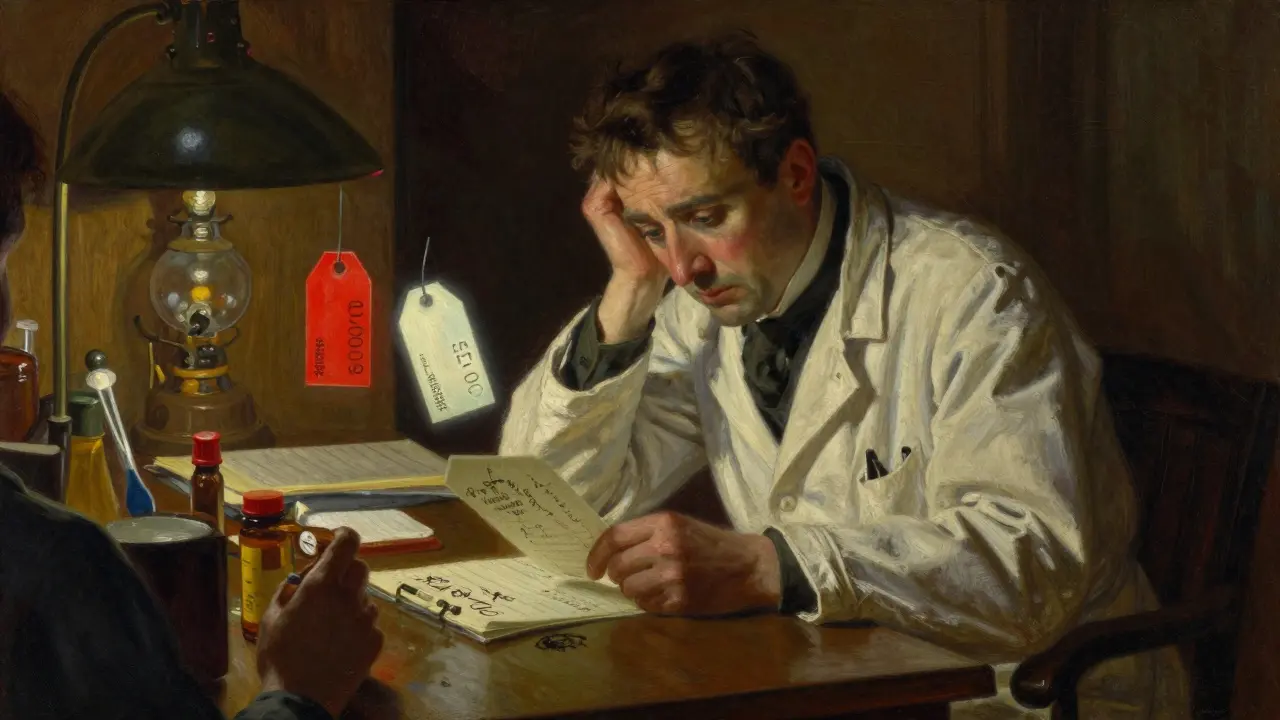
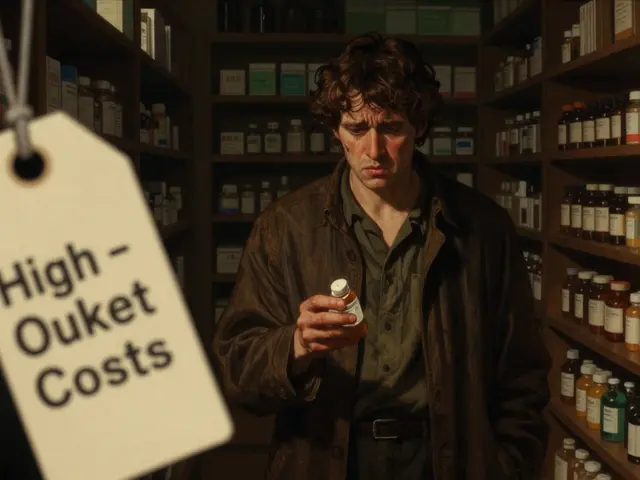
How much does a prescription really cost? For many clinicians, the answer is a guess. Even though drug prices directly affect whether patients fill their prescriptions - and whether they get better - most doctors and nurses don’t know the actual cost of the medications they prescribe. This isn’t just a small oversight. It’s a systemic blind spot with real consequences: patients skip doses, ration pills, or go without treatment because they can’t afford what their provider ordered - often without the provider ever realizing it.
Doctors guess wrong, and it costs patients
A 2007 review of 29 studies found that physicians consistently misjudged drug prices. They overestimated the cost of cheap generics by 31% and underestimated expensive brand-name drugs by 74%. That’s not a rounding error. It means a doctor might think a $5 generic is $6.50 and prescribe a $200 brand-name version thinking it’s only $50. The result? Patients end up with prescriptions they can’t pay for, and clinicians never know why.
Fast forward to 2024, and the problem hasn’t gone away. A 2016 study of 254 medical students and practicing doctors found that only 5.4% of generic drug costs and 13.7% of brand-name drug costs were estimated within 25% of the real price. For three out of every four medications, the clinician had no idea what they actually cost. And here’s the kicker: clinicians were more accurate with expensive drugs than cheap ones. Why? Because expensive drugs stick in memory - they’re the ones that make patients gasp. Cheap ones? They’re invisible.
Why don’t clinicians know the prices?
The answer is simple: they’re not shown them. Most electronic health records (EHRs) don’t display out-of-pocket costs at the point of prescribing. Even when they do, the data is often outdated, incomplete, or confusing. One resident in a Reddit thread described how their system showed insurer-specific pricing but ignored the patient’s actual copay. So the alert said “$12,” but the patient’s plan had a $75 deductible. The doctor didn’t know - and the patient paid $75 anyway.
Surveys show 92% of physicians want cost information at the point of care. But they’re stuck. Checking a drug’s price might take 3 to 5 minutes - time they don’t have. In a 20-minute appointment with 12 patients, that’s an extra hour of work. No wonder many just pick the first option on the formulary list.
Who’s worse at this - students or doctors?
Surprisingly, doctors aren’t much better than students. A 2021 study found that medical students improved slightly with each year of training, but their median score on a 10-question drug pricing quiz was only 6 out of 10. Meanwhile, practicing physicians scored only 17.81 out of 24 on a cost awareness scale - still low. The gap isn’t about experience. It’s about exposure.
Only 44% of medical students understood that drug prices have almost nothing to do with research and development costs. That’s a myth most people believe - including clinicians. The public thinks high prices fund innovation. But data from the Institute for Clinical and Economic Review shows that in 2023, five major drugs saw price hikes with no clinical justification. Humira’s price went up 4.7% - no new indication, no new research. Just profit.

What changes when cost info is built into the system?
Here’s the good news: when cost data is right there, in the EHR, during prescribing, things change - fast.
A 2021 JAMA Network Open study found that physicians with real-time cost alerts were significantly better at estimating prices. Even better, one in eight doctors changed their prescription after seeing an alert. When potential savings were over $20, that number jumped to one in six. In UCHealth’s system, 12.5% of prescriptions were modified after cost alerts. That’s not just saving money - it’s saving health.
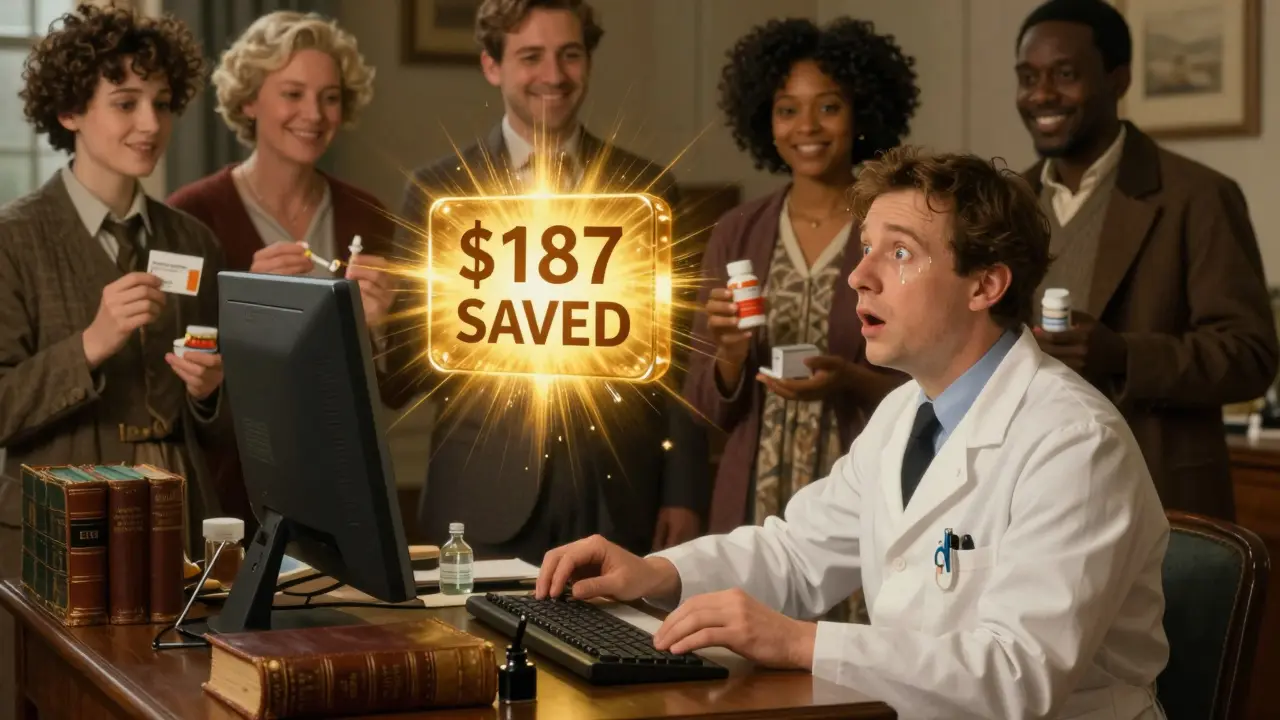
One study showed that patients using these tools saved $187 per year on average. For someone on insulin or a heart medication, that’s not pocket change. That’s whether they take their medicine or not.
Why aren’t more systems using cost alerts?
Because they’re hard to build - and expensive to maintain.
UCHealth spent 18 months and $2.3 million to build their cost transparency tool. The data comes from hundreds of pharmacies, insurers, and rebate programs. And even then, it’s not perfect. A drug might cost $15 at one pharmacy and $320 at another. Which one do you show? The lowest? The one the patient’s insurer uses? The one with the best rebate? There’s no single answer.
Only 37% of U.S. health systems have implemented real-time benefit tools (RTBTs) as of late 2024. Many still rely on outdated formularies or paper references. Mayo Clinic’s Drug Cost Resource Guide - updated quarterly - gets a 4.7/5 rating from users. Medicare’s Part D formulary? Just 2.8/5. Clinicians are hungry for better tools. But they’re not getting them.
Education is missing
Medical schools barely teach drug pricing. A 2021 study found 56% of U.S. medical schools have no formal curriculum on drug costs. Students graduate knowing how a drug works - but not how much it costs. They learn pharmacokinetics, not pharmacoeconomics.
Dr. Daniel Morgan from the University of Maryland put it plainly: “Cost awareness is important in therapeutic reasoning and cost-effective prescribing. Both should be better addressed in (undergraduate) pharmacotherapy education.” Yet it’s still an afterthought.
What’s changing - and what’s next
There’s momentum. The 2022 Inflation Reduction Act let Medicare negotiate drug prices. Public support is strong - 80% of Americans back it, regardless of party. The Centers for Medicare & Medicaid Services now require manufacturers to report out-of-pocket costs. And in safety-net clinics, early data shows cost alerts lead to 22% higher prescription changes than in private practices. That’s huge.
But the biggest shift isn’t technological - it’s cultural. The American Medical Association and the American College of Physicians have made cost-conscious prescribing a professional priority since 2015. It’s no longer optional. It’s part of good care.
By 2027, 75% of U.S. health systems are projected to have advanced RTBTs. But until then, clinicians are flying blind. And patients are paying the price - literally.
What can you do?
If you’re a clinician:
- Ask your EHR vendor if real-time cost alerts are available - and if they’re turned on.
- Use free tools like GoodRx or NeedyMeds to check prices before prescribing.
- Ask patients: “Have you taken this before? Was it affordable?”
- Push for training. If your hospital doesn’t teach drug pricing, demand it.
If you’re a patient:
- Ask your pharmacist: “Is there a cheaper version?”
- Ask your doctor: “Is there a generic? What’s the cash price?”
- Don’t be afraid to say: “I can’t afford this.”
The system is changing. But change won’t happen until clinicians know what their patients are paying - and patients know they have the right to ask.
Do most doctors know how much drugs cost?
No. Studies show that most clinicians misestimate drug prices by large margins - overestimating cheap drugs and underestimating expensive ones. Only about 5% of generic drug costs and 14% of brand-name drug costs are estimated accurately within a 25% margin. This gap exists because cost data is rarely shown at the point of prescribing.
Why don’t EHRs show drug prices?
Many EHRs don’t show drug prices because integrating real-time cost data is complex and expensive. It requires connecting to hundreds of pharmacy networks, insurers, and rebate systems - each with different pricing rules. Some systems show insurer-specific prices but ignore patient-specific copays, making the data misleading. Only 37% of U.S. health systems have implemented reliable tools as of 2024.
Can cost alerts really change prescribing?
Yes. Studies show that when cost alerts are built into EHRs, one in eight doctors change their prescription - and one in six when savings exceed $20. In one system, 12.5% of prescriptions were modified after alerts. Patients using these tools saved $187 per year on average. The change isn’t just about money - it’s about adherence and outcomes.
Is drug pricing related to research and development costs?
Not really. Only 12% of drug prices are tied to R&D. Most price increases come from market power, patent extensions, and lack of competition. For example, Humira’s price rose 4.7% in 2023 with no new indication or clinical improvement. Yet 50% of patients believe high prices fund innovation - a myth that persists even among clinicians.
Are medical schools teaching drug pricing?
No, not enough. A 2021 study found 56% of U.S. medical schools have no formal curriculum on drug pricing. Students learn how drugs work, but not how much they cost. This gap leads to poor prescribing decisions and patient financial harm. Experts say cost awareness must be integrated into pharmacotherapy education - but few schools have done so.


Written by Martha Elena
I'm a pharmaceutical research writer focused on drug safety and pharmacology. I support formulary and pharmacovigilance teams with literature reviews and real‑world evidence analyses. In my off-hours, I write evidence-based articles on medication use, disease management, and dietary supplements. My goal is to turn complex research into clear, practical insights for everyday readers.
All posts: Martha Elena