
You’ve been on the same medication for years. Your doctor switches you to a generic version. You take it. And suddenly, something feels off. Your anxiety spikes. Your blood pressure climbs. You swear it’s not working like before. You go back to your doctor, maybe even ask for the brand name again. But here’s the truth: the active ingredient is exactly the same. So why does it feel different?
Same Medicine, Different Packaging
Generic drugs aren’t knockoffs. They’re not cheaper because they’re weaker. They’re cheaper because they don’t carry the cost of research, marketing, or patent protection. The U.S. Food and Drug Administration (FDA) requires generics to contain the same active ingredient, in the same strength, same form-pill, injection, patch-and same route of administration as the brand-name version. That means if you’re taking levothyroxine for thyroid issues, or sertraline for depression, the core chemical doing the work is identical. The FDA calls this bioequivalence. It’s not a suggestion. It’s a legal requirement.Here’s how they prove it: in clinical studies, 24 to 36 healthy volunteers take both the brand and generic versions. Researchers measure how quickly and how much of the drug enters the bloodstream. The generic must deliver between 80% and 125% of the brand’s absorption rate. That’s a 45% window. And here’s the kicker: for nearly all medications, that tiny variation doesn’t change how well the drug works. Your body doesn’t notice the difference.
Still, people do. And that’s where the problem starts.
The Nocebo Effect: When Your Mind Makes You Sick
Think about this: if someone tells you a pill might cause nausea, you’re more likely to feel nauseous-even if it’s a sugar pill. That’s the nocebo effect. It’s the evil twin of the placebo effect. And it’s happening every day with generic drugs.Studies show that when patients are told, “This is a generic,” they report more side effects and less effectiveness-even when the drug is identical to the brand. A 2023 study in JAMA Network Open proved it. One group was told generics were “just as effective.” Another was told they were “less effective.” The first group stuck with their meds 34% more often. The second group quit 41% more often. The drug didn’t change. The message did.
It’s not just patients. Doctors, too, sometimes hesitate. A 2016 survey found 11% of physicians believed generics were less effective. Another 27% thought they caused more side effects. Why? Because they’ve heard it from patients. Or seen it in their charts. Or remember one case where a patient said it “didn’t work.” But correlation isn’t causation. When someone switches from a blue pill to a white one, and their symptoms flare up, they don’t blame stress, sleep, or diet. They blame the pill. And that story gets passed around.
Why Some Groups Are More Skeptical
This isn’t a universal feeling. It’s uneven. In the U.S., non-Caucasian patients are significantly more likely to distrust generics. A 2015 study found 43% of Black and Hispanic patients doubted their effectiveness, compared to 29% of white patients. In rural Alabama, people describe generics as “for poor folks,” “not real medicine,” or “watered down.” These aren’t just myths-they’re rooted in deeper issues: lack of trust in the healthcare system, past experiences with underfunded clinics, or even seeing generics as a sign you’re being treated differently.And it’s not just about race. It’s about access. People who’ve struggled to afford care often get switched to generics first. That can feel like being pushed to the bottom of the line. When your doctor says, “We’re switching you to the generic to save money,” it doesn’t always sound like cost-saving. It can sound like, “You’re not worth the brand.”
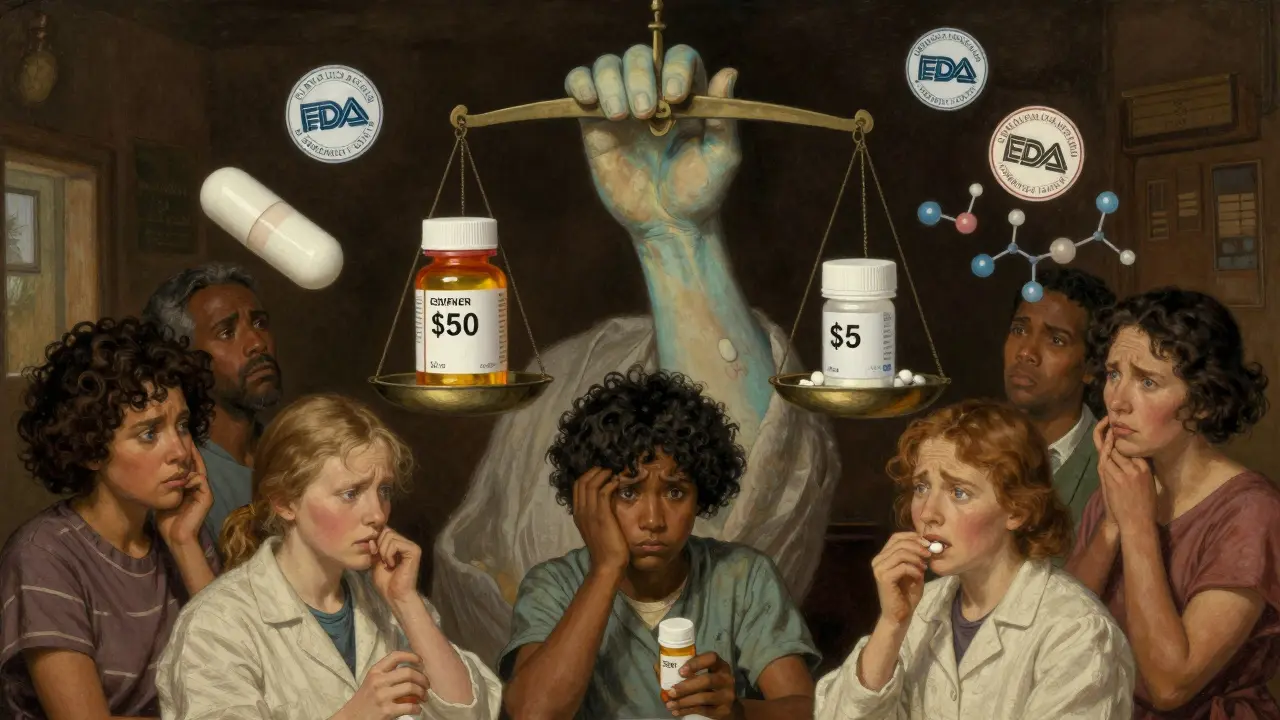
The Cost of Misunderstanding
The science says generics work. The data says they save money. In the U.S., generics make up 90% of all prescriptions filled. And they’ve saved over $1.7 trillion since 2009. But if people stop taking them because they think they don’t work, those savings vanish-and health gets worse.One 2019 study found 22% of patients who believed generics were inferior stopped taking their meds entirely. That’s more than double the rate of those who didn’t have that belief. For someone on blood pressure meds, skipping doses isn’t just inconvenient. It’s dangerous. For someone on epilepsy or thyroid medication, it can be life-threatening.
Pharmacists report patients refusing to refill generics. One pharmacist on Reddit shared a story of a woman who stopped her levothyroxine after switching to the generic. She said, “It just didn’t feel right.” Her TSH levels were normal before. They shot up after. She didn’t know the pills were identical. She just felt worse.
What Actually Works: How to Fix the Problem
You can’t fix this by shouting facts. You can’t fix it by slapping an FDA logo on the bottle. You need communication that sticks.Here’s what does:
- Show the active ingredient. When a patient asks, “Is this the same?” hand them the bottle. Point to the name on the label. “This is levothyroxine. The brand has it. This has it too. Same molecule.” This alone boosts acceptance by 87%.
- Use simple language. Don’t say “bioequivalent.” Say, “It’s the same medicine. Just made by a different company.”
- Give them proof. A printed sheet from the FDA’s website helps-but only if it’s written at a 6th-grade reading level. Most FDA materials are too technical. The average patient can’t understand them.
- Address the fear directly. “I know some people say generics don’t work. That’s a common worry. But here’s what the science says.”
Some places are getting it right. Canada and the UK have public education campaigns that run for years. Their generic acceptance rates? Over 90%. In the U.S., the FDA’s “It’s the Same Medicine” campaign reached 27 million people-but only 19% remembered it. That’s not a campaign. That’s noise.
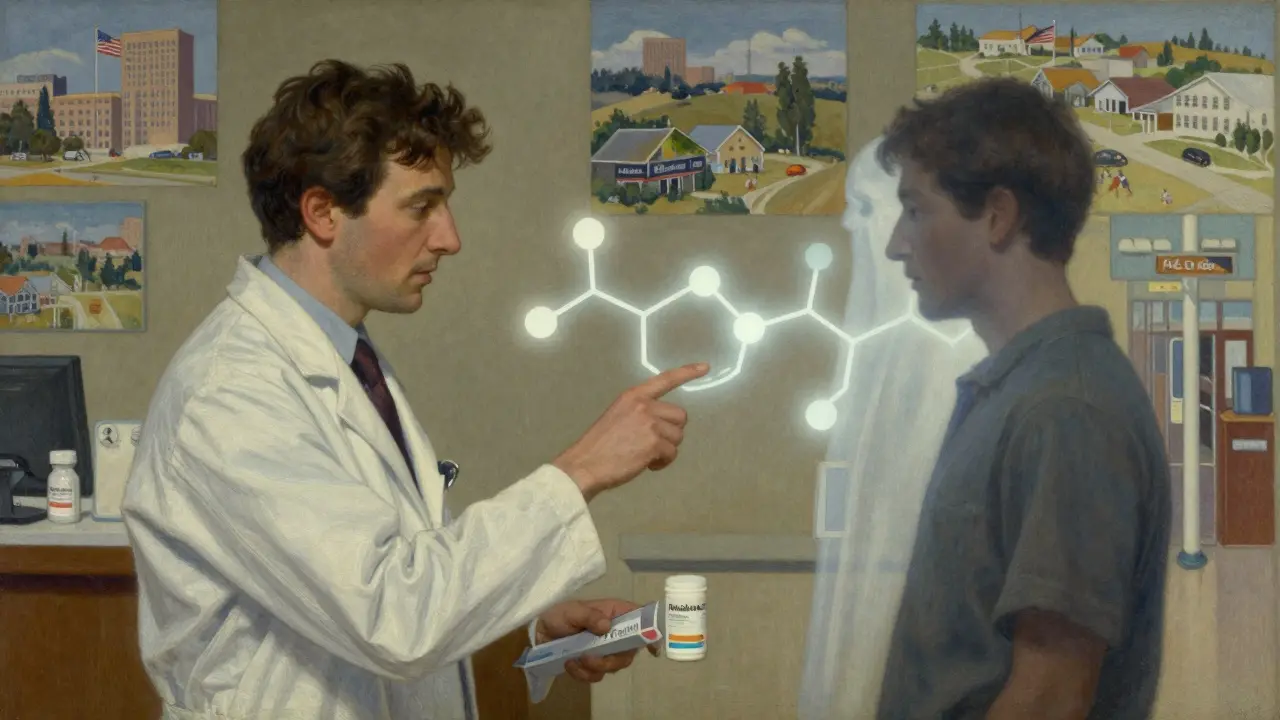
What’s Changing Now
The FDA is finally acting. In 2023, they started requiring therapeutic equivalence ratings on generic packaging. That means you’ll see a letter code-like “AB”-that tells you it’s interchangeable. It’s small, but it’s a start.Medical schools are adding training. The American Medical Association now requires doctors to learn how to talk about generics during continuing education. And the FDA is building a tool called “Equivalence Explorer,” set to launch in 2024. It’ll let patients type in their brand drug and see exactly which generics are approved-and why.
But here’s the hard truth: technology won’t fix this. Education won’t fix this. Only honest, repeated, empathetic conversations will.
Bottom Line: It’s Not the Drug. It’s the Story.
Generics aren’t second-rate. They’re not watered down. They’re not made in shady labs. They’re held to the same standards as the brand. The same factories. The same inspections. The same rules.What’s different? The story. The fear. The assumption. The belief that if it costs less, it must be less.
But medicine isn’t about price tags. It’s about molecules. And those molecules don’t care if you paid $5 or $50.
Next time you’re handed a generic, look at the label. Read the name. Ask: “Is this the same?” The answer is yes. Always.
Are generic drugs really as effective as brand-name drugs?
Yes. The FDA requires generic drugs to have the same active ingredient, strength, dosage form, and route of administration as the brand-name version. They must also prove bioequivalence-meaning they deliver the same amount of medicine into your bloodstream at the same rate. For over 90% of medications, this difference is too small to matter clinically. The FDA states that generics are just as safe and effective as brand-name drugs.
Why do some people feel worse after switching to a generic?
It’s often the nocebo effect-when expecting a negative outcome leads to real symptoms. Switching from a familiar-looking pill to a different color or shape can trigger anxiety. Some people associate generics with lower quality, especially if they’ve been told so by others. In rare cases, inactive ingredients (like fillers) may cause mild reactions, but these are not the same as reduced effectiveness. If you feel worse, talk to your doctor before stopping the medication.
Are all generics made in the U.S.?
No. Many generic drugs are manufactured overseas, especially in India and China. But the FDA inspects all facilities-domestic and foreign-using the same standards. A 2016 report found foreign facilities had more inspectional observations, but that doesn’t mean the drugs are unsafe. It often reflects differences in documentation, not product quality. The final product must meet the same FDA requirements regardless of where it’s made.
Can I ask my doctor to keep me on the brand-name drug?
Yes. You have the right to request the brand-name version. But your doctor may ask why. If cost is a concern, they can often help you find patient assistance programs. If you believe the generic doesn’t work, they can check your lab results and determine whether there’s a real medical reason to switch back. For most drugs, there isn’t.
Do generics have different side effects?
The active ingredient-which causes the main effects and side effects-is identical. However, the inactive ingredients (dyes, fillers, preservatives) can differ. In rare cases, someone may be sensitive to one of those, leading to mild reactions like a rash or upset stomach. These are not signs the drug is less effective. They’re just allergic responses to a filler. If this happens, your pharmacist can check which filler is used and suggest another generic version.





Written by Martha Elena
I'm a pharmaceutical research writer focused on drug safety and pharmacology. I support formulary and pharmacovigilance teams with literature reviews and real‑world evidence analyses. In my off-hours, I write evidence-based articles on medication use, disease management, and dietary supplements. My goal is to turn complex research into clear, practical insights for everyday readers.
All posts: Martha Elena