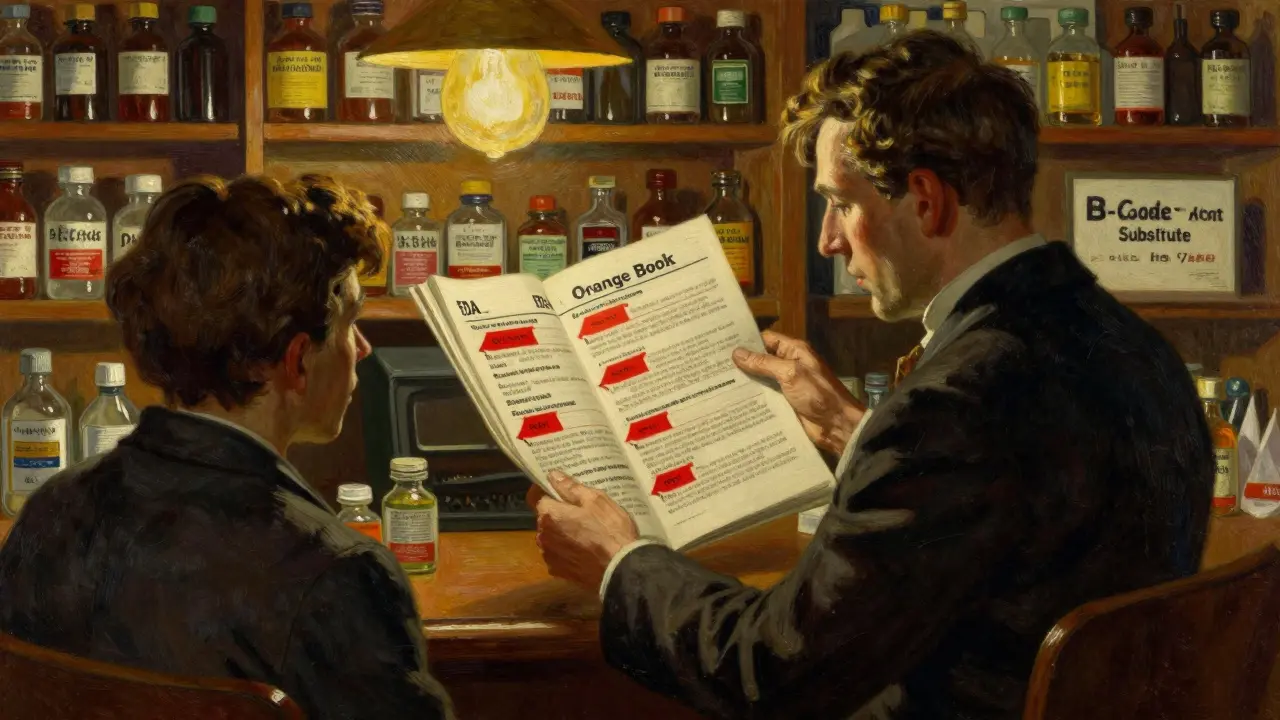
When you're checking if a generic drug is safe to substitute for a brand-name version, or if a biosimilar biologic can be used without risking patient harm, you don't need to guess. The FDA has two official tools built for exactly this: the Orange Book and the Purple Book. These aren't just reference guides-they're live safety dashboards used daily by pharmacists, doctors, and regulators to prevent dangerous substitutions and ensure patients get safe, effective medications.
What the Orange Book Tells You About Drug Safety
The FDA Orange Book, officially called Approved Drug Products with Therapeutic Equivalence Evaluations, is the go-to source for small-molecule drugs-think pills, capsules, and liquids. It’s been around since 1985, and as of September 2023, it lists over 20,000 approved products. But what matters most for safety isn’t the total number-it’s what’s missing.
Section II of the Orange Book is where safety red flags show up. It’s called the Discontinued Section, and it lists drugs pulled from the market because of safety or effectiveness issues. These aren’t old products sitting on a shelf-they’re active warnings. If a generic version of a drug was pulled because it caused liver damage or irregular heart rhythms, that’s right there in bold. The FDA adds a footnote: “Federal Register determination that product was discontinued or withdrawn for safety or efficacy reasons.” That’s your signal to stop and double-check.
Here’s how it works in practice: A pharmacist in Ohio recently caught a dangerous mix-up. A patient’s prescription was filled with a generic version of a drug that had been withdrawn in 2021 for causing severe allergic reactions. The brand-name version was still on the market, but the generic wasn’t. The Orange Book flagged it immediately. Without that check, the patient could have been hospitalized.
Therapeutic equivalence codes are another safety layer. These are one-letter codes next to each drug entry. An “A” code means the generic is considered therapeutically equivalent to the brand-same active ingredient, same dose, same safety profile. But if you see a “B,” that’s a red flag. It means the FDA doesn’t consider it interchangeable. That’s often because of differences in how the drug is absorbed, especially for drugs with a narrow therapeutic index-like warfarin, levothyroxine, or phenytoin. Even a small change in blood levels can cause a seizure, a stroke, or a blood clot.
What the Purple Book Reveals About Biological Safety
If the Orange Book is for pills, the Purple Book is for biologics-complex drugs made from living cells. Think insulin, rheumatoid arthritis treatments like Humira, or cancer drugs like Herceptin. These aren’t chemically synthesized like traditional drugs. They’re made in labs using living tissue, so even tiny changes in production can affect safety.
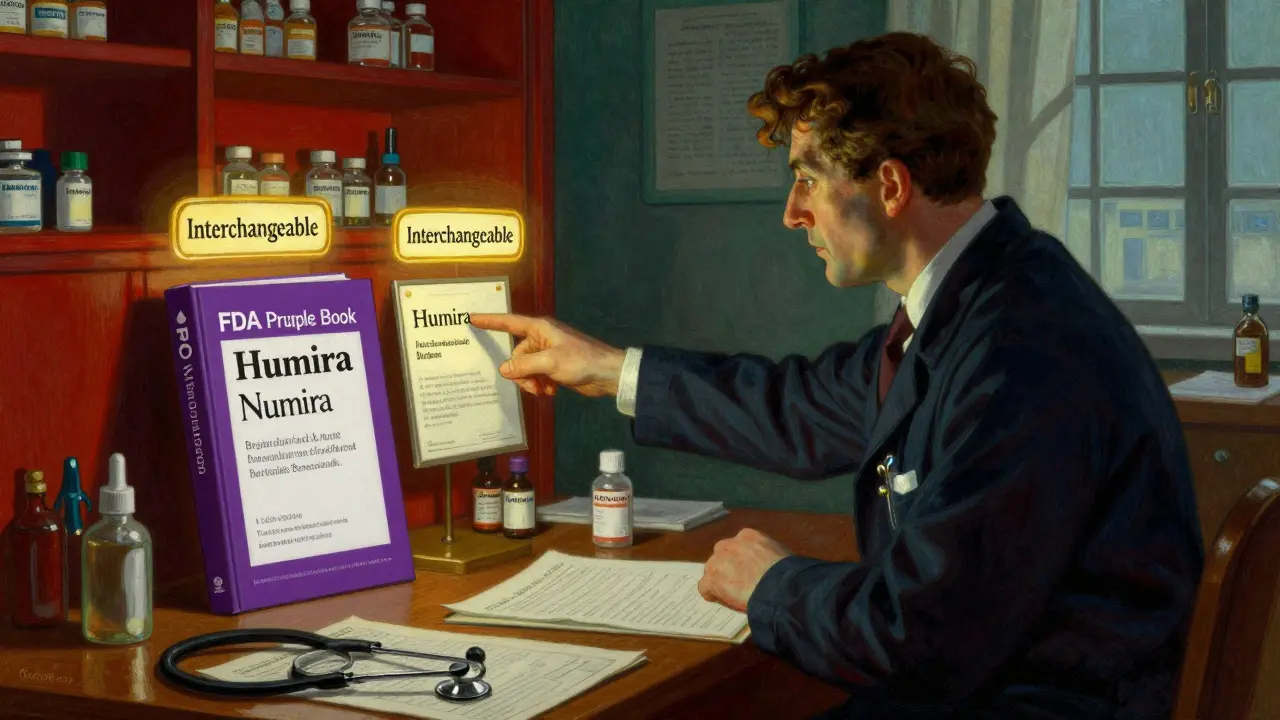
The Purple Book, launched in 2014, lists over 400 licensed biological products, including more than 40 biosimilars and interchangeable versions. But its real power isn’t just listing them-it’s showing you how they compare to the original product. Every biosimilar entry is grouped under its reference product. That means you can see all the copies of Humira in one place, with clear labels: “Biosimilar” or “Interchangeable.”
“Interchangeable” is the gold standard. It means the FDA has reviewed clinical data proving you can switch between the biosimilar and the original product back and forth without increasing safety risks. That’s not just a marketing term-it’s a regulatory decision based on real-world outcomes. For example, the biosimilar for adalimumab (Humira) was deemed interchangeable after studies showed no increase in immune reactions or infection rates compared to the original.
But here’s the catch: the Purple Book doesn’t track side effects after approval. If a biosimilar starts causing more joint pain or rashes in real patients, that won’t show up here. That data lives in the FDA’s Adverse Event Reporting System (FAERS). The Purple Book tells you if the drug met the safety bar at approval-but you still need to watch for signals after it’s on the market.
How to Search the Orange Book for Safety Alerts
You don’t need to be a pharmacist to use the Orange Book. The FDA’s website lets anyone search it for free. Here’s how to find safety issues fast:
- Go to the FDA Orange Book database.
- Under “Search Options,” select “Discontinued Drug Products.”
- Set “Reason for Discontinuation” to “Safety.”
- Click “Search.”
As of September 2023, this filter returns 127 products that were pulled for safety reasons. You’ll see the drug name, the brand, the manufacturer, and the exact reason it was removed. No jargon. No hidden links. Just clear facts.
If you’re checking a specific generic, type the drug name into the main search bar. Look for the “Therapeutic Equivalence Code.” If it’s “B,” don’t substitute without consulting the prescriber. For high-risk drugs like digoxin or lithium, even a “B” code can mean serious consequences.
How to Use the Purple Book for Biosimilar Safety Decisions
Using the Purple Book is a little different. You’re not looking for withdrawn drugs-you’re comparing safety profiles.
- Visit the FDA Purple Book database.
- Search by the reference product name-like “adalimumab” or “etanercept.”
- Look at the “Biosimilarity or Interchangeability” column.
- Click on any biosimilar to see the full safety evaluation summary.
Only products labeled “Interchangeable” have been proven safe for automatic substitution. “Biosimilar” means it’s similar, but switching back and forth hasn’t been fully studied. That’s why some states still require prescriber approval before swapping a biosimilar for the original.
Also check the “Reference Product Exclusivity” column. If the exclusivity period has expired, it means the reference product’s safety data is older and more established. Newer biosimilars may have less long-term data, even if they passed initial approval.
What These Books Don’t Tell You
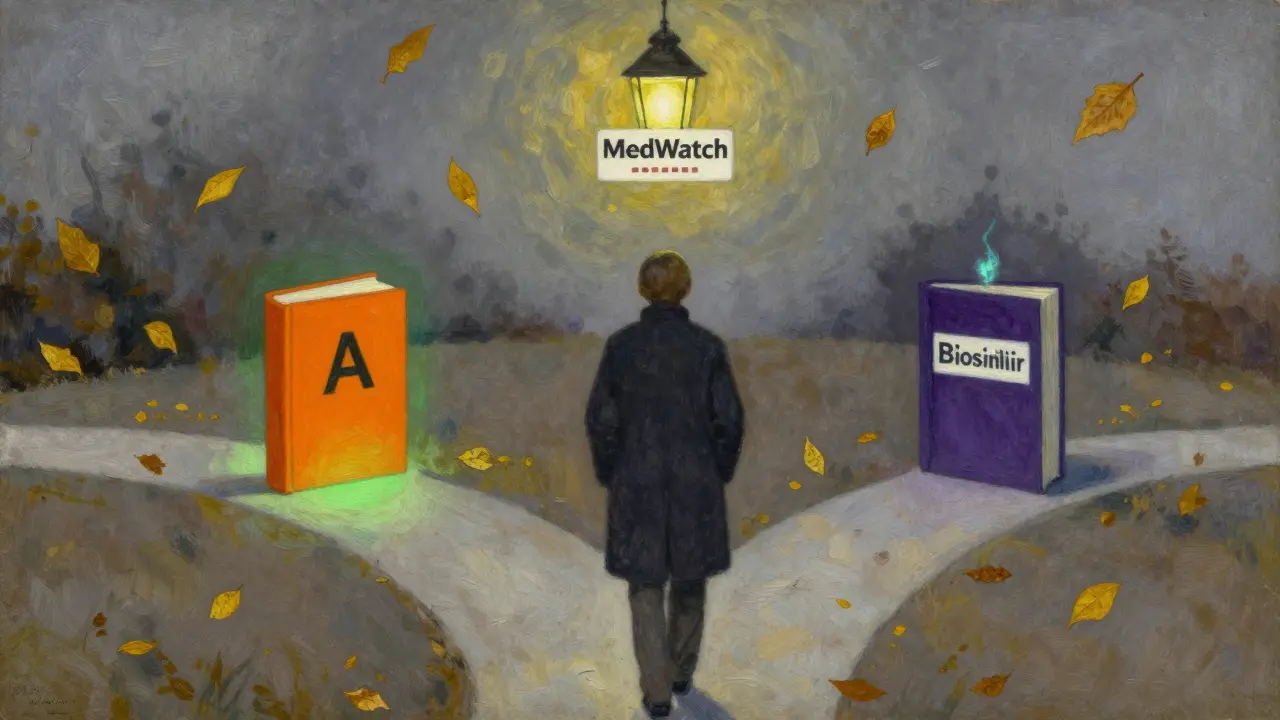
Neither the Orange Book nor the Purple Book shows you real-time adverse events. They don’t tell you if 200 people reported dizziness last month, or if a batch had contamination issues. That’s what the FDA’s MedWatch and FAERS systems are for.
Here’s a real example: In 2022, a biosimilar for rituximab (used in lymphoma) showed a spike in infusion reactions in post-market reports. The Purple Book hadn’t been updated yet-it still said “interchangeable.” But MedWatch alerts had already warned providers. The safety info in the Purple Book was correct at approval, but it didn’t reflect new risks emerging in the field.
That’s why smart clinicians use all three: Orange Book for generic substitution safety, Purple Book for biosimilar comparisons, and MedWatch for emerging signals. The books give you the legal and regulatory foundation. Real-world data gives you the context.
Who Uses These Tools and Why
Ninety-eight percent of U.S. pharmacies use the Orange Book daily, according to the National Community Pharmacists Association. For them, it’s not optional-it’s a legal safeguard. If a pharmacist substitutes a drug that’s been withdrawn for safety reasons, they can be held liable.
Biotech companies rely on the Purple Book to navigate patent cliffs and regulatory pathways. If they want to launch a biosimilar, they must prove safety equivalence to a reference product listed in the Purple Book. That’s why the book is often the first document reviewed in regulatory filings.
Even patients are starting to use these tools. A 2023 survey found that 1 in 5 patients with chronic conditions like rheumatoid arthritis checked the Purple Book before agreeing to a biosimilar switch. They weren’t trying to be experts-they just wanted to know if it was safe.
What’s Changing in 2025
The FDA is making both books more powerful. In 2023, the Orange Book added “Safety Signal” flags for drugs showing early warning signs-like a rise in liver enzyme reports-before they’re officially withdrawn. That’s a big step toward proactive safety.
The Purple Book’s update cycle is still slower than the Orange Book’s-60 days versus 30. But Congress allocated $5.2 million in 2023 to speed that up. By 2025, both databases will be fully integrated, letting you search for safety data across small molecules and biologics in one place.
And the FDA is testing machine learning to automatically flag potential safety issues by analyzing thousands of adverse event reports. That means in the future, a drug might get a warning in the Orange Book before a doctor even reports a problem.
Bottom Line: Safety Starts With These Two Books
If you’re prescribing, dispensing, or taking a drug, the Orange Book and Purple Book are your first line of defense. They don’t replace clinical judgment-but they give you facts you can’t get anywhere else. A generic isn’t automatically safe just because it’s cheaper. A biosimilar isn’t interchangeable just because it looks the same. These books tell you the truth.
Check the Orange Book before filling a generic prescription. Use the Purple Book when considering a biosimilar switch. And always cross-check with MedWatch for the latest safety alerts. Your patients depend on it.
Can I trust generic drugs listed in the Orange Book?
Yes-if they have an “A” therapeutic equivalence code. That means the FDA has confirmed the generic has the same active ingredient, strength, dosage form, and safety profile as the brand-name drug. But if the code is “B,” the FDA does not consider it interchangeable. That’s often due to differences in how the drug is absorbed, especially for narrow therapeutic index drugs like warfarin or levothyroxine. Always check the code before substituting.
Does the Purple Book tell me if a biosimilar is safer than the original?
No. The Purple Book only tells you whether a biosimilar has been shown to have no clinically meaningful differences in safety compared to the original product. It doesn’t say one is safer than the other. “Interchangeable” means you can switch back and forth without added risk, but it doesn’t mean the biosimilar is better or safer overall. Long-term safety data still comes from post-market monitoring.
Are discontinued drugs in the Orange Book still available in other countries?
Yes. The Orange Book only reflects U.S. regulatory decisions. A drug withdrawn in the U.S. for safety reasons may still be sold in other countries with different risk thresholds or reporting systems. Never assume a drug is safe just because it’s available overseas. U.S. safety standards are based on domestic data and patient outcomes.
How often are the Orange Book and Purple Book updated?
The Orange Book is updated every 30 days with new approvals, withdrawals, and therapeutic equivalence changes. The Purple Book is updated every 60 days. This delay is a known limitation, especially for fast-moving biologics. Always check for the most recent version before making safety decisions, and supplement with FDA MedWatch alerts for real-time safety signals.
Can I use these books to check for drug recalls?
Not directly. The Orange Book and Purple Book list drugs withdrawn for safety or efficacy reasons by FDA regulatory action, not product recalls initiated by manufacturers. Recalls for contamination, labeling errors, or packaging defects are published separately on the FDA’s Recall page. Always cross-reference both the Orange/Purple Books and the FDA Recall website for full safety coverage.
Do I need special training to use these books?
No. Both databases are free, public, and designed for non-experts. The FDA offers free 90-minute webinars quarterly on how to read them. The key is knowing what to look for: therapeutic equivalence codes in the Orange Book and biosimilarity status in the Purple Book. Start with the FDA’s “How to Read the Orange Book” guide-it’s updated annually and explains everything in plain language.



![Sartel (Telmisartan) Uses, Dosage, Side Effects, Interactions [2025 Guide]](/uploads/2025/08/thumbnail-sartel-telmisartan-uses-dosage-side-effects-interactions-2025-guide.webp)
Written by Martha Elena
I'm a pharmaceutical research writer focused on drug safety and pharmacology. I support formulary and pharmacovigilance teams with literature reviews and real‑world evidence analyses. In my off-hours, I write evidence-based articles on medication use, disease management, and dietary supplements. My goal is to turn complex research into clear, practical insights for everyday readers.
All posts: Martha Elena