Hair Loss Treatment Calculator
Compare Your Treatment Options
This calculator helps you choose between Dutasteride and Finasteride based on your priorities
How important is maximum hair growth to you?
How much do you want to minimize side effects?
How important is cost to you?
How important is FDA approval for hair loss?
Your Recommended Option
Quick Takeaways
- Both drugs block the conversion of testosterone to DHT, the main trigger of male‑pattern baldness.
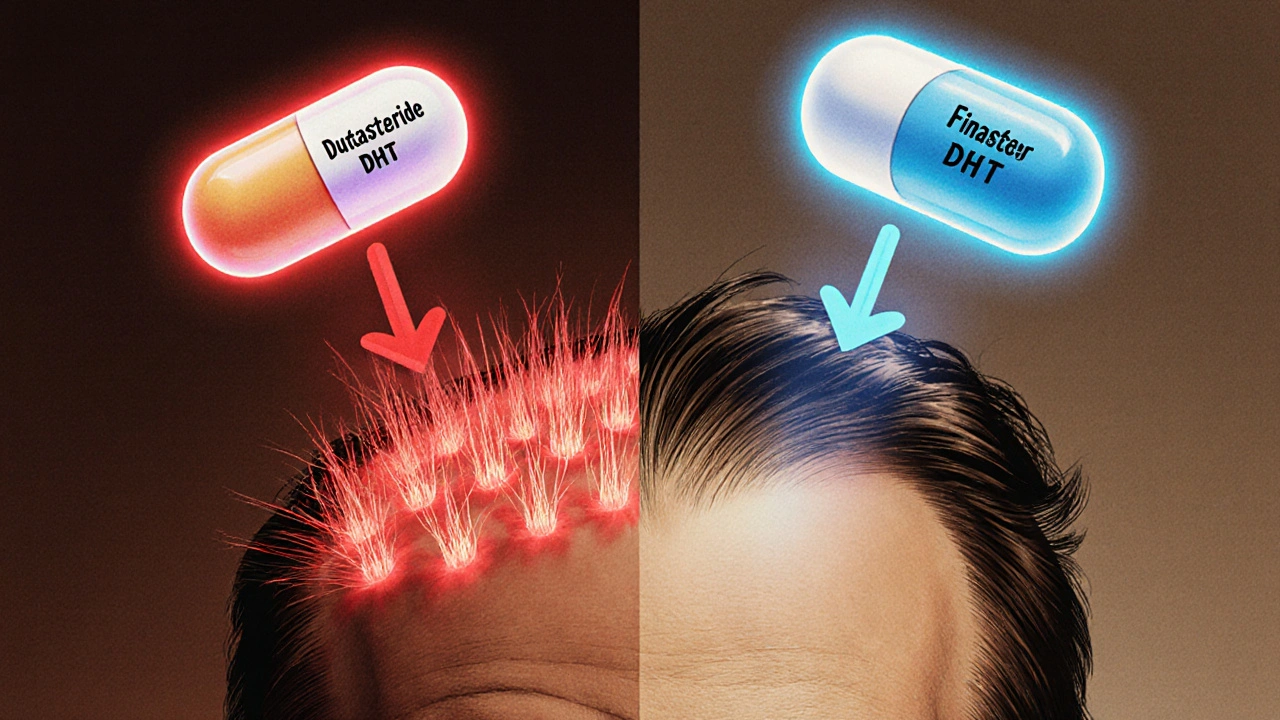
- Dutasteride inhibits both type I and II 5α‑reductase enzymes, giving it a roughly 30‑40% higher efficacy in clinical trials.
- Finasteride is FDA‑approved for hair loss; dutasteride is approved for BPH and used off‑label for hair.
- Side‑effect profiles are similar, but dutasteride carries a slightly higher risk of sexual dysfunction.
- Cost, availability, and personal tolerance usually decide which one wins for you.
When it comes to thinning hair, the battle often narrows down to two names you’ll see on pharmacy shelves or online forums: Dutasteride is a dual 5α‑reductase inhibitor originally approved for benign prostate enlargement (BPH) and Finasteride, a selective type II 5α‑reductase inhibitor approved for both BPH and male‑pattern hair loss. If you’ve Googled “Dutasteride vs. Finasteride for hair loss”, you’re looking for the answer to a simple question: which pill gives you more hair with fewer drawbacks? Below we break down the science, the numbers, and the everyday considerations that help you decide.
What is Androgenetic Alopecia?
Androgenetic alopecia (often called male‑pattern baldness) affects roughly 30 % of men by age 30 and over 70 % by age 60. It’s not just a cosmetic quirk; it’s driven by the hormone dihydrotestosterone (DHT). DHT binds to receptors in hair follicles, shortening the growth phase and eventually miniaturizing the shaft. Over time, the follicles produce fine, almost invisible hairs, leading to the classic receding hairline and crown thinning.
How Dutasteride Works
Like a double‑acting blocker, dutasteride targets both isoforms of the enzyme 5α‑reductase-type I (found mainly in the skin and liver) and type II (concentrated in the prostate and hair follicles). By shutting down both pathways, dutasteride can lower scalp DHT levels by up to 95 %, compared with a 70 %‑80 % reduction seen with finasteride. The result is a more pronounced slowdown of follicle mini‑miniaturization.
How Finasteride Works
Finasteride zeroes in on the type II isoform, which is heavily involved in hair‑follicle DHT production. A daily 1 mg dose typically cuts scalp DHT by about 70 % and has been FDA‑approved for the treatment of androgenetic alopecia since 1997 under the brand name Propecia. Its narrower focus means a slightly lower potency, but also a long track‑record of safety data.
Efficacy Comparison
Clinical trials give us a clear picture of how the two stack up. Below is a snapshot of the most cited studies, converted into a simple side‑by‑side view.
| Metric | Dutasteride (0.5 mg daily) | Finasteride (1 mg daily) |
|---|---|---|
| Average hair‑count increase (per cm²) | +108 ± 25 | +78 ± 22 |
| Percentage of participants with >15 % increase | 68 % | 46 % |
| Mean DHT reduction (scalp) | ≈95 % | ≈70 % |
| Reported sexual side‑effects | 7‑9 % | 4‑6 % |
In short, dutasteride consistently delivers a higher hair‑count boost and a larger proportion of responders, but it also nudges the side‑effect rate up a notch.
Safety, Side Effects, and Who Should Avoid Them
Both drugs share a handful of common adverse events-decreased libido, erectile dysfunction, and occasional mood shifts. Because dutasteride hits both enzyme types, the incidence of these effects leans toward the higher end of the range. Most men notice the symptoms within the first three months, and they often improve after discontinuation.
Pregnant women should never handle crushed or broken tablets; even tiny amounts of DHT‑blocking agents can harm a male fetus’s developing genitalia. For men planning to father children, a wash‑out period of at least three months is recommended after stopping either medication.
People with a history of prostate cancer should discuss treatment with a urologist. While both drugs lower DHT, they can also mask prostate‑specific antigen (PSA) levels, potentially delaying diagnosis.
Practical Considerations: Cost, Availability, and Prescription Status
Finasteride enjoys a generic market in New Zealand, Australia, the UK, and the US, typically costing between $15‑$30 per month. Dutasteride, marketed as Avodart for BPH, is pricier-around $50‑$80 monthly. Because dutasteride’s hair‑loss use is off‑label, insurers rarely cover it, and some doctors may need to write a special prescription.
The dosing schedules differ as well. Finasteride is taken at 1 mg a day for hair loss; dutasteride’s hair‑loss dose is usually 0.5 mg daily, half the BPH dose (0.5 mg for BPH, 0.5 mg for hair). Both require a commitment of at least six months before visible results.
How to Choose the Right Option for You
- Assess your treatment goals. If you need the strongest growth boost and can tolerate a slightly higher odds of side effects, dutasteride might be worth a trial.
- Check regulatory status. Finasteride is FDA‑approved (and approved by New Zealand Medsafe) for hair loss, which gives you a clearer safety profile and easier insurance coverage.
- Consider cost and access. For most men, the cheaper finasteride makes sense as a first‑line option.
- Talk to a healthcare professional. A dermatologist can run a baseline hormone panel, discuss family history, and help you decide if a combination therapy (e.g., dutasteride + minoxidil) is appropriate.
- Plan for monitoring. Schedule follow‑up labs (PSA, liver enzymes) at three‑month intervals, especially if you choose dutasteride.
Many clinicians start patients on finasteride, evaluate response after six months, and then consider escalating to dutasteride if growth is inadequate. This step‑wise approach balances efficacy, safety, and cost.
Frequently Asked Questions
Can I use dutasteride and finasteride together?
Combining them offers no extra benefit because both block the same enzyme pathways. Using both increases side‑effect risk without improving hair growth.
How long before I see results?
Most men notice a slowdown in shedding within 2‑3 months and measurable regrowth after 6‑12 months of daily use.
Is dutasteride safe for women?
No. Women who are pregnant or could become pregnant should avoid handling dutasteride tablets because of the risk to a male fetus. It is not prescribed for female pattern hair loss.
Do these pills work for a receding hairline?
They are most effective on the crown and mid‑scalp. The frontal hairline often requires additional treatments like minoxidil or low‑level laser therapy.
What should I do if I experience sexual side effects?
Talk to your doctor. Often a dose reduction or a switch to the other medication alleviates the issue. In many cases, symptoms resolve after stopping the drug.
Bottom line: Dutasteride vs Finasteride isn’t a one‑size‑fits‑all answer. If you prioritize maximum regrowth and are comfortable with a modestly higher side‑effect chance, dutasteride could be the better fit. If you prefer a tried‑and‑true, FDA‑approved route with more insurance coverage, finasteride remains the go‑to choice. Either way, a conversation with a dermatologist or hair‑loss specialist will help you tailor the plan to your scalp, budget, and health profile.




Written by Martha Elena
I'm a pharmaceutical research writer focused on drug safety and pharmacology. I support formulary and pharmacovigilance teams with literature reviews and real‑world evidence analyses. In my off-hours, I write evidence-based articles on medication use, disease management, and dietary supplements. My goal is to turn complex research into clear, practical insights for everyday readers.
All posts: Martha Elena