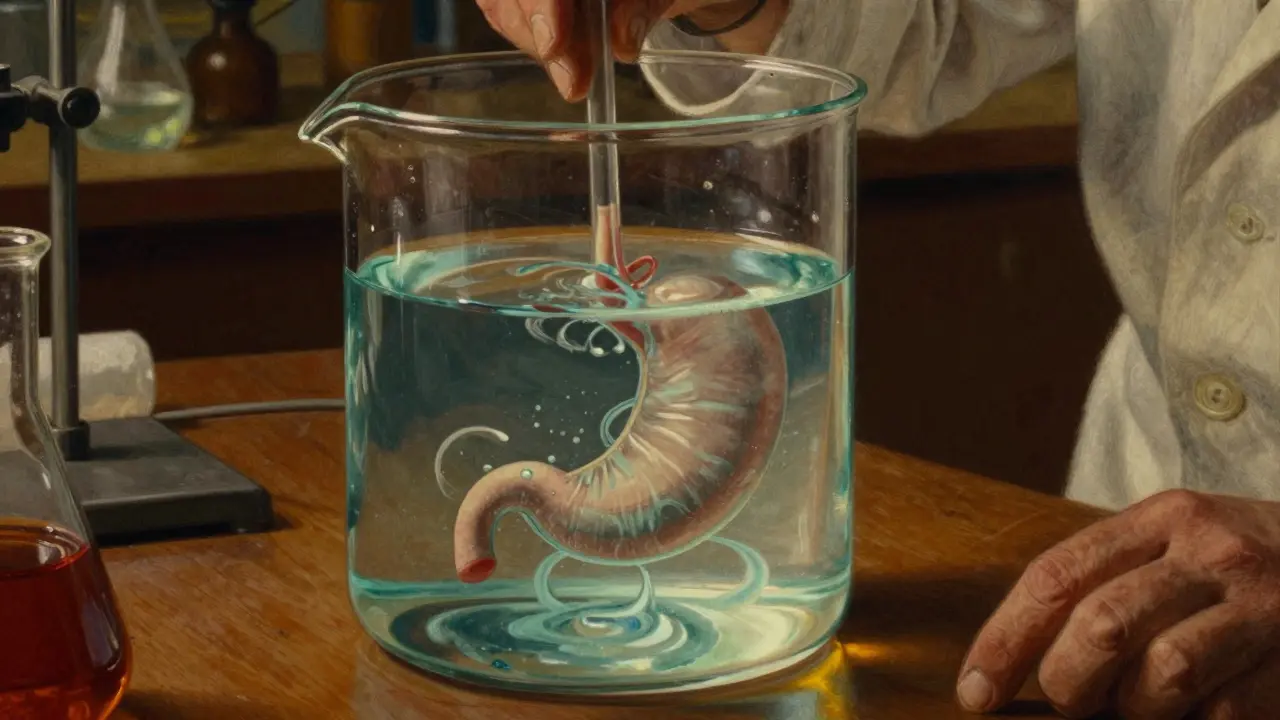
Ever wonder why a generic pill works exactly the same as the expensive brand-name version? It isn't just luck. Before a generic drug ever hits the pharmacy shelf, it has to pass a grueling series of tests to prove it releases its active ingredients into your system at the right speed. This is where dissolution testing is a critical quality control process that measures the rate at which a drug substance dissolves in a liquid medium. For the FDA, this test is the primary gatekeeper that ensures a generic is therapeutically equivalent to its brand-name counterpart.
The Core Goal: Predicting How a Drug Behaves in Your Body
The ultimate goal for any generic drug is bioequivalence standards. In simple terms, this means the generic drug must deliver the same amount of active ingredient to the bloodstream at the same rate as the Reference Listed Drug (RLD). However, testing this on thousands of humans for every single generic version would be slow, expensive, and often unnecessary.
The FDA uses dissolution testing as an "in vitro" (outside the body) predictor of "in vivo" (inside the body) performance. By simulating the environment of the stomach or intestines in a lab, scientists can see if a tablet disintegrates and releases its API-or active pharmaceutical ingredient-comparably to the original. If the dissolution profiles match, there is a high probability the drug will behave the same way in a patient.
The ANDA Process and the Five Pillars of Data
When a company wants to sell a generic drug, they submit an Abbreviated New Drug Application (or ANDA) a regulatory pathway that allows generic manufacturers to bypass expensive clinical trials by proving bioequivalence . Since they don't have to redo the original clinical trials, the FDA shifts the focus to rigorous chemistry and dissolution data.
According to the latest FDA guidance from September 2023, manufacturers can't just wing it. They must provide data across five specific categories to prove their method is reliable:
- Solubility Characteristics: How the bulk drug substance naturally behaves in different liquids.
- Test Conditions: Specifics on the gear used, such as USP Apparatus 1 (basket) or USP Apparatus 2 (paddle), including rotation speed (often 50-100 rpm) and the exact pH of the buffers.
- Method Robustness: Proving that slight changes in the test environment don't wildly swing the results.
- Analytical Validity: Ensuring the tools used to measure the dissolved drug are accurate.
- Discriminatory Ability: The test must be sensitive enough to tell the difference between a good batch and a bad one, especially for sustained-release pills.
Different Rules for Different Drugs: The BCS System
Not all pills are created equal. Some dissolve instantly, while others are designed to leak medicine slowly over 24 hours. To manage this, the FDA uses the Biopharmaceutical Classification System (or BCS) a framework that classifies drugs based on their solubility and permeability .
For BCS Class I drugs-which have both high solubility and high permeability-the FDA offers a shortcut called a "biowaiver." If a manufacturer can prove the dissolution profile is nearly identical to the brand name, the FDA may waive the need for human bioequivalence studies entirely. For these high-solubility drugs, the standard is often a single-point test: 80% or more of the drug must be released within 30 to 45 minutes in 900 mL of 0.1N HCl.
| Drug Category | Primary Requirement | FDA Focus | Human Study Need |
|---|---|---|---|
| BCS Class I (High Solubility) | Single-point test (e.g., 30 min) | Rapid release | Often Waived (Biowaiver) |
| Modified-Release (Sustained) | Multi-point, multi-pH testing | Release consistency/Dose-dumping | Usually Required |
| Low Solubility APIs | Discriminatory method validation | In vitro/In vivo correlation | Required |
The Challenge of Modified-Release and "Dose-Dumping"
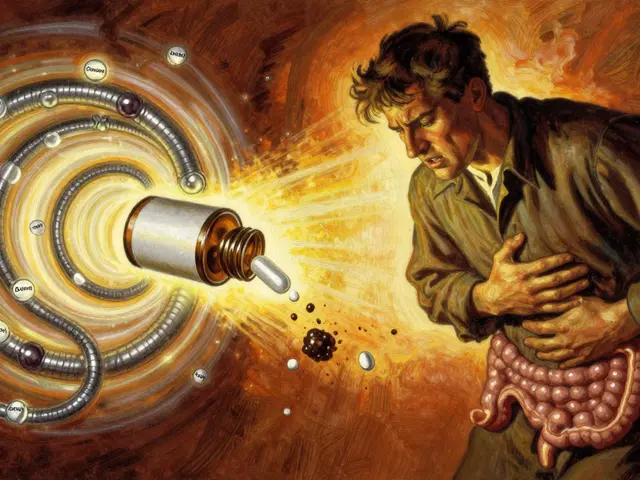
Modified-release drugs are a different beast. Because they are designed to release medicine slowly, a major safety concern is "dose-dumping." This happens when a drug that's supposed to last 12 hours suddenly releases everything at once, which could lead to an overdose.
To prevent this, the FDA requires testing under multiple pH conditions (typically 1.2 for the stomach, 4.5 and 6.8 for the intestines). They even mandate "alcohol challenge testing," where the drug is tested in up to 40% ethanol. Why? Because some coatings that slow down drug release dissolve instantly in alcohol, which would be dangerous for a patient drinking a glass of wine with their medication.
How the FDA Measures "Similarity"
When comparing the generic (test) and the brand (reference), the FDA doesn't just look at the graphs and say, "looks close enough." They use a mathematical tool called the f2 similarity factor a statistical calculation used to compare the similarity of two dissolution profiles . This factor ranges from 0 to 100. If the f2 value is 50 or higher, the FDA considers the two profiles statistically equivalent. If it falls below 50, the generic may be rejected or required to undergo more extensive human testing.
Maintaining Quality After Approval: SUPAC
Quality control doesn't end once the drug is approved. If a manufacturer wants to change their API source or move to a different factory, they can't just start shipping the new version. They must follow the SUPAC-IR (Scale-Up and Post-Approval Changes for Immediate Release) FDA guidelines that dictate how manufacturers must document changes to the manufacturing process framework.
Under SUPAC, any change to the manufacturing site or excipient levels requires the company to prove that the dissolution profile hasn't shifted. If the new process changes how the drug dissolves, the FDA may view it as a different product entirely, requiring a new ANDA submission.
Real-World Hurdles for Manufacturers
While these rules keep us safe, they create a massive mountain of paperwork for companies. Developing a dissolution method for a complex modified-release drug can take 6 to 12 months of lab work. When submitting an ANDA, companies often have to provide 50 to 100 pages of data just for the dissolution section (specifically in module 3.2.P.5).
To help, the FDA maintains the Dissolution Methods Database. As of 2023, this database provides recommended methods for nearly 2,900 drug products. It acts as a starting point, though the FDA still insists that every method be "product-specific" to ensure that the unique chemistry of each pill is accounted for.
What happens if a generic drug fails the dissolution test?
If a generic fails to meet the acceptance criteria or the f2 similarity factor is below 50, the FDA will generally not approve the ANDA. The manufacturer must either reformulate the drug to match the brand-name's release profile or conduct extensive in vivo bioequivalence studies (human trials) to prove that the difference in dissolution doesn't actually affect how the drug works in the body.
Does every single generic drug need a human bioequivalence study?
No. For certain types of drugs, specifically those in BCS Class I (high solubility and high permeability), the FDA may grant a "biowaiver." This allows the company to skip human trials if they can prove the dissolution profile is nearly identical to the reference drug, which significantly speeds up the approval process.
What is the 'alcohol challenge test' and why is it used?
The alcohol challenge test involves testing the dissolution of a modified-release drug in a medium containing up to 40% ethanol. This is done to ensure that alcohol doesn't cause the drug's slow-release coating to fail, which could lead to "dose-dumping"-the dangerous release of the entire dose at once.
How often does the FDA update its dissolution standards?
The FDA updates its guidance documents periodically as science evolves. A major update occurred in September 2023, which placed stricter requirements on how manufacturers must validate their dissolution methods, regardless of whether they use an official USP method or their own internal process.
What is the difference between a USP method and an FDA-recommended method?
A USP method is a standardized test from the U.S. Pharmacopeia that is legally binding for all manufacturers of that drug. An FDA-recommended method is a suggestion found in the FDA's Dissolution Methods Database to help companies develop their own tests when a formal USP method doesn't exist or isn't sufficient.
Next Steps for Drug Development
For those working in pharmaceutical development, the path forward involves a tight loop of method development and verification. If you're dealing with a low-solubility API, your first priority should be proving the "discriminatory ability" of your test-basically, proving your test can fail a bad batch.
If you are scaling up production, keep the SUPAC-IR guidelines on your desk. Any change in the source of your API or a shift in the amount of filler (excipients) could trigger a requirement for new comparative dissolution data. When in doubt, refer to the FDA Dissolution Methods Database to see if there is a pre-approved starting point for your specific formulation.





Written by Martha Elena
I'm a pharmaceutical research writer focused on drug safety and pharmacology. I support formulary and pharmacovigilance teams with literature reviews and real‑world evidence analyses. In my off-hours, I write evidence-based articles on medication use, disease management, and dietary supplements. My goal is to turn complex research into clear, practical insights for everyday readers.
All posts: Martha Elena