
Imagine waking up one morning and feeling a glimmer of hope after months-or even years-of being trapped in the heavy fog of depression. That is exactly what Ketamine is a dissociative anesthetic repurposed as a rapid-acting treatment for severe depression that often works within hours rather than weeks offers to many people. For those who have tried multiple standard antidepressants without success, these treatments are not just another option; they can be a lifeline. But with two main forms available-IV ketamine and nasal spray esketamine (brand name Spravato)-choosing between them can feel overwhelming. Both work fast, but they differ significantly in how they are administered, their effectiveness, side effects, and cost.
Understanding Treatment-Resistant Depression
Before diving into the specifics of these medications, it helps to understand who needs them. About 30% of adults with major depressive disorder do not respond adequately to two or more standard antidepressant trials. This condition is known as Treatment-Resistant Depression (TRD) is a form of depression that does not improve despite trying at least two different antidepressant medications at adequate doses and durations. If you fall into this category, waiting six to eight weeks for a new pill to kick in is often not feasible, especially if you are experiencing suicidal thoughts or severe functional impairment. This is where ketamine and its derivative, esketamine, come into play. They offer a different mechanism of action, targeting the brain’s glutamate system rather than serotonin or dopamine, which allows for much faster symptom relief.
The Core Difference: IV Ketamine vs. Nasal Spray Esketamine
While both drugs share a similar chemical structure, their delivery methods and regulatory statuses create distinct patient experiences. Let’s break down the practical differences.
| Feature | IV Ketamine | Intranasal Esketamine (Spravato®) |
|---|---|---|
| Administration | Intravenous infusion (40 mins) | Nasal spray (two sprays per nostril) |
| FDA Status for Depression | Off-label use | Approved (since March 2019) |
| Speed of Onset | Immediate (after first dose) | Delayed (often requires 2+ doses) |
| Efficacy Reduction* | ~49% reduction in scores | ~40% reduction in scores |
| Dissociation Side Effects | Higher (42.3% of patients) | Lower (28.7% of patients) |
| Average Cost (8 doses) | $4,200 - $5,600 | $5,800 - $6,900 |
*Data based on a 2025 comparative study from Mass General Brigham involving 153 adult patients.
Why IV Ketamine Might Be Better for Severe Cases
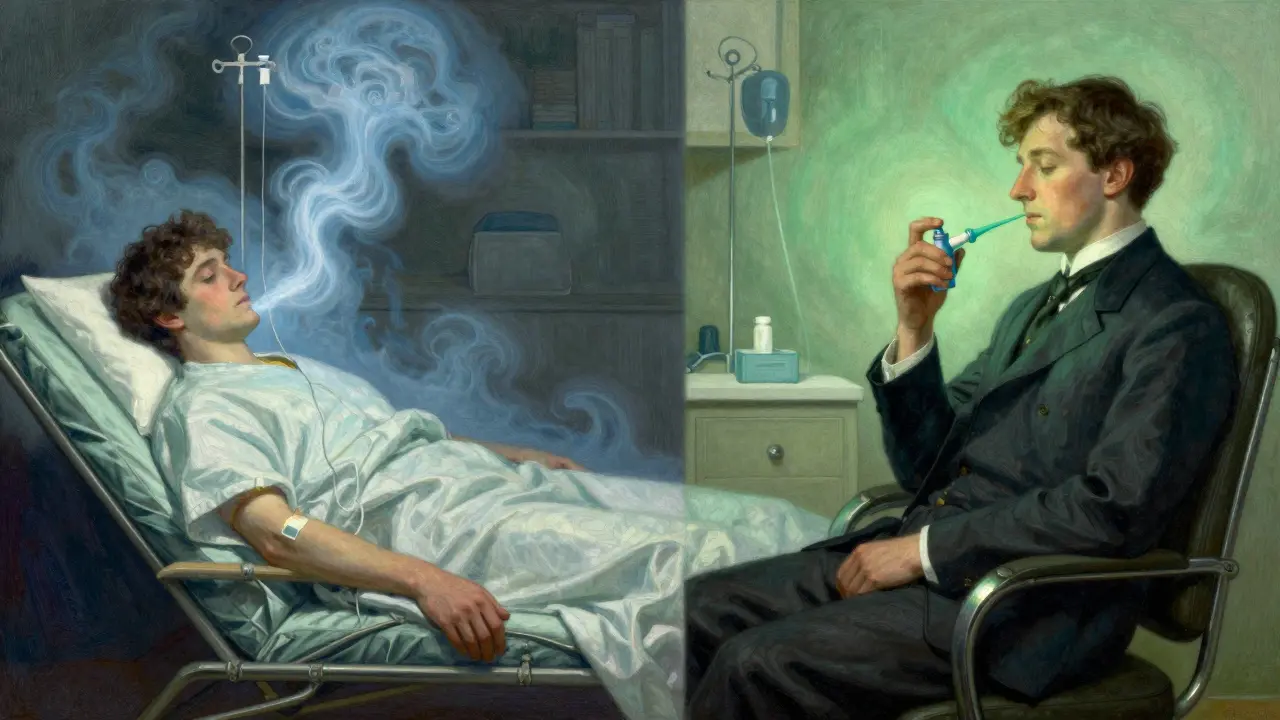
If your primary goal is maximum efficacy and speed, IV ketamine currently holds the edge. A landmark retrospective analysis published in the Journal of Clinical Psychiatry in September 2025 compared outcomes for 111 patients receiving IV ketamine versus 42 receiving intranasal esketamine. The results were clear: IV ketamine produced a 49.22% reduction in depression severity scores by the final dose, compared to 39.55% for esketamine. More importantly, the onset was immediate. Patients reported feeling better right after the first infusion. In contrast, esketamine users typically needed at least two treatments before seeing significant improvement.
This makes IV ketamine particularly attractive for individuals facing life-threatening depression or acute suicidal ideation where every hour counts. Dr. John Krystal, Chief of Psychiatry at Yale New Haven Hospital, noted in a May 2025 editorial that IV ketamine’s superior efficacy profile makes it preferable for severe cases requiring a rapid response. However, this potency comes with a trade-off: higher rates of dissociation. In the same study, 42.3% of IV ketamine patients experienced dissociative symptoms, such as feeling detached from reality or their body. While usually temporary and monitored, this can be intense for some.
The Case for Esketamine: Convenience and Safety
Esketamine, marketed as Spravato is an FDA-approved nasal spray containing the S-enantiomer of ketamine, designed for easier administration and fewer dissociative side effects, offers a different value proposition. Because it is only the "S" part of the ketamine molecule, it tends to produce less pronounced dissociative effects. The FDA’s clinical trial data shows a 37.2% lower incidence of severe dissociative symptoms compared to racemic ketamine. For many patients, this means a more manageable treatment experience.
Convenience is another major factor. Administering a nasal spray is far less invasive than having an IV inserted. You don’t need specialized venous access or advanced airway management training for the provider, just basic life support certification. This allows esketamine to be prescribed in more outpatient psychiatric settings. Dr. Christine Denny of Columbia University highlighted in a 2024 commentary that esketamine’s favorable safety profile makes it better suited for maintenance therapy. If you are looking for long-term stability rather than emergency rescue, the ease of twice-weekly nasal sprays might fit your lifestyle better than weekly infusions.
Cost and Insurance Coverage: The Hidden Barrier
Money is often the deciding factor. Even if a treatment is clinically superior, you can’t take it if you can’t afford it. Here is the reality of the costs in 2026:
- IV Ketamine: A full course of eight treatments averages between $4,200 and $5,600 out-of-pocket. Since it is off-label for depression, insurance coverage is spotty. According to the National Alliance on Mental Illness (NAMI) June 2025 report, only 38.2% of commercial plans cover IV ketamine for depression.
- Esketamine (Spravato): A comparable course costs approximately $5,800 to $6,900. However, because it is FDA-approved specifically for TRD, coverage is much better. About 67.4% of commercial insurance plans cover Spravato.
Despite the higher upfront price tag, esketamine may actually be more affordable for insured patients due to broader coverage. Conversely, if you are paying cash, IV ketamine is cheaper. It is also worth noting that a July 2025 cost-effectiveness analysis in JAMA Psychiatry found IV ketamine to be more cost-effective overall ($14,327 per quality-adjusted life year gained vs. $18,764 for esketamine), largely because it achieves greater symptom reduction.

What Do Real Patients Say?
Clinical trials provide data, but patient experiences provide context. Aggregated reviews from over 1,200 users on mental health forums like PatientsLikeMe (as of September 2025) reveal interesting trends. While 63.2% of IV ketamine users reported significant symptom relief within 24 hours, only 62.9% rated their overall treatment experience as "good" or "excellent." The intense dissociation and need for IV access made the process stressful for some.
In contrast, while only 51.7% of esketamine users felt relief within the first day, a whopping 78.4% rated their overall experience positively. Why? Because the non-invasive nature and milder side effects made the journey less daunting. If you are sensitive to medical procedures or anxious about "losing control," esketamine might feel like a safer psychological bet, even if it takes slightly longer to work.
Safety, Monitoring, and Long-Term Outlook
Neither of these treatments is something you can self-administer at home. Both require mandatory 2-hour post-treatment monitoring in a certified clinic. This is crucial because both drugs can cause dizziness, nausea, and increased blood pressure. The American Society of Anesthesiologists’ 2025 guidance specifies that IV ketamine requires providers with advanced airway management skills, whereas esketamine clinics need only basic life support certification.
Regarding long-term efficacy, data is still emerging. A 2024 multicenter trial showed that 56.3% of IV ketamine responders maintained remission at six months with maintenance dosing every 1-3 weeks, compared to 48.7% for esketamine. This suggests IV ketamine might have a slight edge in durability, but individual responses vary wildly. Emerging research also points to biomarkers, such as changes in gamma power in brain EEG scans, which could help predict who will respond best to which treatment in the near future.
How to Choose: A Decision Guide
So, which one should you pick? There is no one-size-fits-all answer, but here is a simple heuristic to guide your discussion with your psychiatrist:
- Choose IV Ketamine if: You have severe, life-threatening depression or active suicidal thoughts and need the fastest possible relief. You prioritize maximum efficacy over comfort and are willing to deal with stronger dissociative side effects. You have good insurance coverage for off-label treatments or can pay out-of-pocket.
- Choose Esketamine (Spravato) if: You want a less invasive, more convenient treatment option. You are sensitive to dissociation or find IVs anxiety-inducing. Your insurance covers FDA-approved treatments well. You are looking for a sustainable maintenance therapy rather than an emergency intervention.
Remember, both options are considered second-line treatments after failing two standard antidepressants. Always consult with a qualified healthcare provider who can evaluate your specific medical history, current medications, and risk factors. Access remains a challenge, with only 12.4% of U.S. counties having certified Spravato centers and even fewer offering IV ketamine, so checking local availability early is key.
Is ketamine addictive?
Ketamine is classified as a Schedule III controlled substance by the DEA, indicating a moderate potential for abuse. However, when administered under strict medical supervision in a clinical setting for depression, the risk of addiction is low. The doses used for therapeutic purposes are subanesthetic and carefully monitored, unlike recreational use.
How quickly does esketamine work compared to ketamine?
IV ketamine typically produces immediate symptom relief after the first dose. Esketamine, while still rapid-acting compared to traditional antidepressants, often requires two or more treatments before significant improvements are observed. Studies show IV ketamine has a faster therapeutic onset.
Does insurance cover ketamine therapy for depression?
Coverage varies widely. Esketamine (Spravato) is FDA-approved for treatment-resistant depression, so about 67% of commercial plans cover it. IV ketamine is used off-label for depression, meaning only about 38% of plans cover it. You must verify with your specific insurer and provider.
What are the common side effects of these treatments?
Common side effects include dissociation (feeling detached from reality), dizziness, nausea, and increased blood pressure. IV ketamine is associated with higher rates of dissociation (42.3%) compared to esketamine (28.7%). All patients must be monitored for two hours after treatment.
Can I drive after receiving ketamine or esketamine?
No. Due to the sedative and dissociative effects, you cannot drive or operate heavy machinery for the rest of the day. You must arrange for someone to drive you to and from the clinic and stay with you during the mandatory 2-hour observation period.


Written by Martha Elena
I'm a pharmaceutical research writer focused on drug safety and pharmacology. I support formulary and pharmacovigilance teams with literature reviews and real‑world evidence analyses. In my off-hours, I write evidence-based articles on medication use, disease management, and dietary supplements. My goal is to turn complex research into clear, practical insights for everyday readers.
All posts: Martha Elena