
When a drug has a narow therapeutic index, even tiny changes in how much of it enters your bloodstream can mean the difference between healing and harm. Think of warfarin, phenytoin, or levothyroxine - these aren’t just any pills. One milligram too much could cause internal bleeding. One milligram too little could trigger a seizure or thyroid crisis. That’s why generic versions of these drugs don’t get the same approval path as regular generics. Around the world, regulators are wrestling with how to make safe, affordable NTI generics without risking patient lives.
What Makes NTI Drugs So Tricky?
NTI stands for narrow therapeutic index. It means the gap between a dose that works and a dose that’s dangerous is razor-thin. For most drugs, a 20% variation in blood levels might not matter. For NTI drugs, that same shift can be life-threatening. The FDA defines these drugs as those where small differences in concentration can lead to serious therapeutic failure or adverse reactions. That’s why they’re not treated like ordinary generics.
Examples aren’t rare. Warfarin, used to prevent blood clots, has a narrow window. Too little, and you get a stroke. Too much, and you bleed internally. Phenytoin, an anti-seizure drug, behaves the same way. Even levothyroxine, often thought of as a simple hormone replacement, falls into this category. Studies show that switching brands - even FDA-approved generics - can cause thyroid levels to swing in vulnerable patients. In one 2023 Reddit thread, pharmacists shared cases where patients had abnormal TSH levels after switching generic levothyroxine brands, even though all were labeled as bioequivalent.
How the FDA Handles NTI Generics
The U.S. Food and Drug Administration (FDA) tightened its rules for NTI generics in 2010. Before that, they used the same 80-125% bioequivalence range as regular generics. Now, for NTI drugs, the acceptable range is often tighter - sometimes 90-111% or even narrower, depending on the drug. The quality assay limit, which measures how much active ingredient is in each pill, is also stricter: 95-105% instead of the usual 90-110%.
These aren’t just numbers on paper. They come from real-world data. The FDA found that some generic versions of NTI drugs, even if they met the old standards, caused unpredictable blood levels in patients. That’s why they now require more detailed bioequivalence studies - often using healthy volunteers instead of patients, to remove variables like metabolism differences. Dr. Janet Woodcock, former head of FDA’s drug center, said bluntly in 2019: “For NTI drugs, we apply tighter limits.”
But the system isn’t perfect. In 2022, the FDA rejected 22% more NTI generic applications than non-NTI ones, mostly due to bioequivalence issues. And while the FDA approves a generic, individual states can still block pharmacists from substituting it. North Carolina requires written consent from both doctor and patient before switching an NTI drug. Connecticut, Idaho, and Illinois have special rules for anti-epileptic drugs. Twenty-six U.S. states have some form of extra restriction on NTI substitution.
The European Approach: Fragmented but Strict
In Europe, there’s no single regulator. Instead, you’ve got 27 countries, each with its own rules - but they’re trying to unify under the European Medicines Agency (EMA). The EMA offers three main paths: the Centralized Procedure (CP), which gives approval across all EU nations; the National Procedure (NP), which only covers one country; and the Mutual Recognition Procedure, where one country’s approval is shared with others.
The Centralized Procedure is becoming more popular. In 2018, only 42% of new generic applications used it. By 2022, that jumped to 68%. Why? Because it avoids the headache of applying separately in each country. The process takes about 210 days - longer than the FDA’s average, but more consistent.
Unlike the U.S., Europe doesn’t have state-level substitution laws. But pricing is where things get wild. In 24 of 27 EU countries, governments cap generic prices - often forcing the first generic to be at least 40% cheaper than the brand. Spain, for example, requires subsequent generics to match or undercut that price. That drives down costs fast, but it also squeezes manufacturers. Some experts say this is why fewer companies invest in complex NTI generics in Europe.
Still, the EMA’s bioequivalence standards are just as strict as the FDA’s. They require multi-point dissolution testing, stability studies under stress conditions, and sometimes even population bioequivalence models - especially for modified-release formulations. These are the hardest NTI drugs to get right: pills that release drug slowly over hours. A small change in how they dissolve can throw off blood levels.

Canada, Japan, and Other Key Players
Health Canada has taken a pragmatic route. They allow foreign reference products - like the U.S. or EU brand - to be used in bioequivalence studies, as long as the formulation, solubility, and physicochemical properties match exactly. This saves time and money for manufacturers who already have data from other markets.
Japan’s Pharmaceuticals and Medical Devices Agency (PMDA) has detailed guidance for topical NTI drugs, which are especially hard to replicate because skin absorption varies so much between people. They’ve published specific protocols for creams and ointments, something few other regulators have done.
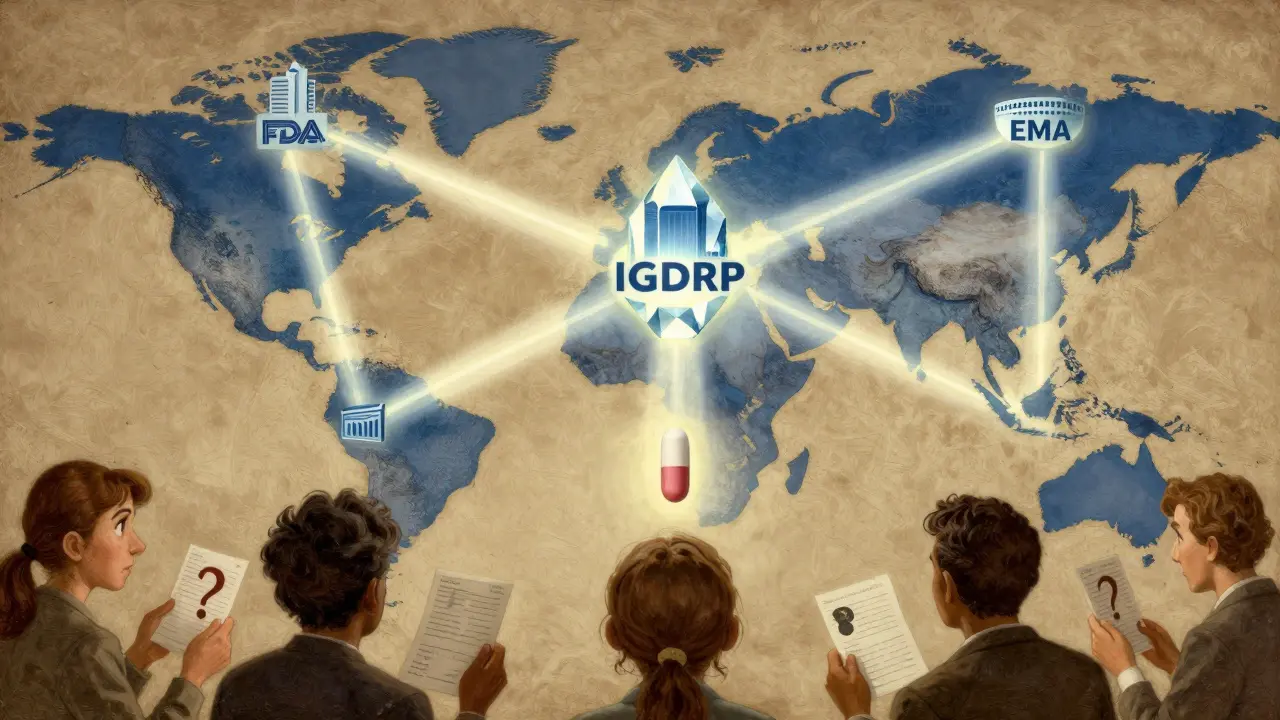
Meanwhile, countries like Brazil, Mexico, Singapore, and South Korea have little to no public guidance for NTI generics. That creates a huge gap. A manufacturer might get approval in the U.S. and EU, then struggle to enter markets where regulators don’t even have clear criteria. This fragmentation is one reason the International Generic Drug Regulators Pilot (IGDRP) was created in 2012. It includes the FDA, EMA, Health Canada, PMDA, and others. Their goal? Align standards so one study can work in multiple countries.
Cost, Time, and the Real Price of Compliance
Developing a regular generic drug can cost $2-4 million and take 12-18 months. For an NTI generic? That jumps to $5-7 million and 18-24 months. Why? More studies. More testing. More data. More back-and-forth with regulators.
Companies have to run multiple bioequivalence trials, test stability under heat and humidity, simulate shelf life over years, and sometimes even use predictive modeling to guess how the drug will behave in different patients. One regulatory affairs executive at Accord Healthcare told a 2023 interview that “you can’t cut corners on NTI drugs - one failed batch can cost millions in recalls.”
That’s what happened in 2021 when nitrosamine impurities were found in a generic blood pressure drug. Even though it wasn’t an NTI drug, the fallout was massive. For NTI drugs, the stakes are higher. A recall doesn’t just mean lost revenue - it means patients might stop taking their medication out of fear.
Market Reality: Who’s Winning and Who’s Losing
The global NTI generics market hit $48.7 billion in 2022 and is expected to grow to $72.3 billion by 2027. The U.S. leads with 42% of sales, followed by Europe at 34%. Teva is the biggest player, holding nearly 19% of the market. Mylan, Sandoz, and Hikma follow.
But adoption varies wildly. Warfarin generics are used in 92% of cases in the U.S. - because doctors trust them. Levothyroxine? Only 67%. Why? Because even small changes in thyroid levels can cause fatigue, weight gain, or heart issues. A 2021 study across 15 European countries found that when strict bioequivalence rules were followed, 94.7% of patients had no change in clinical outcomes. But when those rules weren’t enforced - or when patients switched brands too often - problems popped up.
Pharmacists report the same thing. A 2019 survey found 67% of U.S. pharmacists get requests from doctors to avoid substituting NTI generics. In Europe, 58% of hospital pharmacists said they’re confused by the rules across countries. It’s not that generics are unsafe - it’s that the system makes it hard to know which ones are truly equivalent.
What’s Next? Harmonization and New Science
The future of NTI generics lies in better science and more cooperation. The ICH M9 guideline, adopted in 2023, allows some drugs to skip bioequivalence studies if they fit into a biopharmaceutics classification system - but only if they’re not NTI drugs. That’s a missed opportunity. Experts are pushing to expand ICH M9 to include NTI drugs with proven solubility and absorption profiles.
The FDA is planning to roll out population bioequivalence models by 2025. Instead of testing 24 healthy volunteers, they’ll use computer models to predict how thousands of real patients would respond. This could cut study costs and speed up approvals.
Meanwhile, the IGDRP is gaining traction. If regulators in the U.S., EU, Canada, and Japan can agree on one set of standards for dissolution testing or bioequivalence limits, manufacturers won’t need to run five different studies. That could reduce approval times by 25-30% over the next decade, according to Dr. Jessica Greene of the University of Minnesota.
But the biggest hurdle isn’t science - it’s politics. Countries want control over their own markets. Price controls, substitution laws, and national pride all get in the way. Until regulators stop treating NTI generics like a local issue and start seeing them as a global patient safety issue, patients will keep paying the price - in anxiety, in cost, and sometimes, in health.







Written by Martha Elena
I'm a pharmaceutical research writer focused on drug safety and pharmacology. I support formulary and pharmacovigilance teams with literature reviews and real‑world evidence analyses. In my off-hours, I write evidence-based articles on medication use, disease management, and dietary supplements. My goal is to turn complex research into clear, practical insights for everyday readers.
All posts: Martha Elena