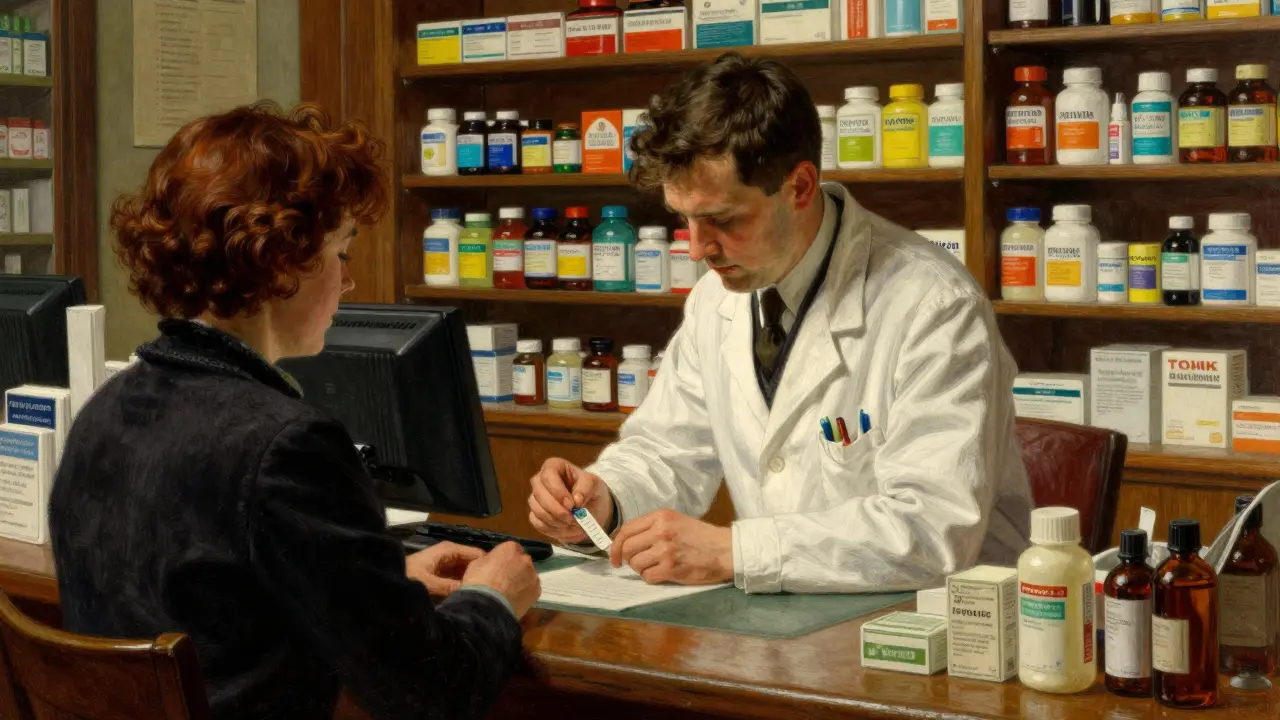
Imagine picking up your blood pressure medication, only to discover later that the bottle actually belongs to someone with a completely different health profile. This isn't a scene from a medical thriller; it is a preventable reality known as a wrong-patient error, which is a critical safety incident where medications are dispensed to an individual other than the one for whom they were prescribed. According to the Institute for Safe Medication Practices (ISMP), these errors are among the most dangerous categories of medication mistakes because they can lead to severe allergic reactions, fatal drug interactions, or simply leave a patient without their life-saving treatment.
The stakes are high. The Agency for Healthcare Research and Quality reported in 2022 that adverse drug events contribute to approximately 1.3 million emergency department visits annually in the United States alone. While much attention focuses on prescription writing errors, the final step-the handoff at the pharmacy counter-is where many of these incidents occur. The good news? These errors are entirely preventable. By combining robust identification protocols with modern technology, pharmacies can create a safety net that protects every patient who walks through the door.
The Core Problem: Why Wrong-Patient Errors Happen
To fix the problem, we first need to understand why it happens. It is rarely due to malicious intent or extreme negligence. More often, it stems from systemic pressures and human limitations. In a busy community pharmacy, staff members may handle hundreds of prescriptions daily. Fatigue, distractions, and the sheer volume of transactions create an environment where cognitive shortcuts become tempting.
A significant contributor is the prevalence of sound-alike and look-alike names. The ECRI Institute’s 2025 medication safety alert highlights that approximately 22% of wrong-patient errors in community pharmacies involve patients with similar names. For example, confusing "John Smith" with "Jon Smyth" or "Mary Johnson" with "Marie Johnston" is easy when you are rushing. Additionally, patients often share physical similarities or have family members picking up prescriptions, further complicating visual identification.
The Joint Commission has tracked this issue since implementing its National Patient Safety Goals in 2003. Despite decades of awareness, medication-related wrong-patient incidents remain among the top root causes of sentinel events. This persistence proves that relying on staff vigilance alone is insufficient. As Dr. Michael Cohen, President of ISMP, stated in the 2025 ISMP Alert, "Pharmacies must implement technological and process safeguards that make errors impossible rather than merely preventing them."
Strategy 1: Standardized Dual-Identifier Verification
The foundation of any prevention strategy is rigorous patient identification. The gold standard, mandated by the Joint Commission for hospital settings and adopted by major chains like CVS Health and Walgreens, is the use of two unique patient identifiers. This typically involves verifying the patient's full legal name and date of birth.
Here is how this works in practice:
- Request Identification: Before releasing any medication, the pharmacist or technician asks the customer for their full name and date of birth.
- Cross-Reference Records: The staff member compares this information against three sources: the printed prescription label, the pharmacy management software screen, and any physical ID presented by the patient.
- Mandatory Match: If there is any discrepancy-even a minor typo in the system-the transaction stops until the correct patient record is confirmed.
This manual verification process reduces wrong-patient errors by approximately 45%, according to a 2022 analysis by Pharmacy Times. However, it is not foolproof. During peak hours, staff might rush through the questions, or patients might provide incorrect dates of birth due to memory issues, particularly among elderly populations. Therefore, while dual-identifier verification is essential, it should be viewed as the baseline, not the complete solution.
Strategy 2: Leveraging Technology for Precision
Technology removes the guesswork from patient identification. When implemented correctly, digital safeguards act as a hard stop that prevents errors before they reach the patient.
| Technology | Error Reduction Rate | Implementation Cost | Key Benefit |
|---|---|---|---|
| Manual Dual-ID Verification | ~45% | Low (Training only) | Immediate implementation |
| Barcode Scanning Systems | 63%-78% | $15,000-$50,000 per location | High accuracy, automated match |
| RFID Wristbands (Hospital) | ~78% | High (Hardware + Integration) | Contactless, fast processing |
| Biometric Fingerprinting | 92% (Pilot data) | Medium-High | Unique identity, hard to fake |
Barcode Scanning: This is currently the most widely adopted technological solution. Patients present an ID card or a prescription receipt with a unique barcode. The scanner reads this code and instantly matches it against the pharmacy database. Walgreens implemented such a system across more than 9,000 locations in 2021, reporting a 63% reduction in wrong-patient errors within 18 months. The beauty of this system is that it eliminates human error in reading names or dates.
RFID Technology: Primarily used in hospital settings, Radio Frequency Identification (RFID) allows for contactless verification. A 2023 study published in the American Journal of Health-System Pharmacy documented a 78% reduction in wrong-patient dispensing errors when RFID wristbands were used alongside barcode scanning. This is particularly useful in fast-paced clinical environments where speed and accuracy are both critical.
Software Safeguards: Modern pharmacy software systems like PioneerRx and QS/1 now include mandatory dual-identifier fields. These systems will not allow a transaction to close unless the entered name and date of birth match the stored records exactly. This creates a digital checkpoint that forces compliance with safety protocols.
Strategy 3: The Human Firewall-Patient Counseling
Technology is powerful, but humans are still the final line of defense. Patient counseling serves as a critical safety net. During this interaction, the pharmacist reviews the medication with the patient, confirming details such as dosage, frequency, and purpose.
According to Pharmacy Times, approximately 83% of dispensing errors are discovered during the counseling phase and corrected before the patient leaves the pharmacy. This happens because the conversation provides multiple opportunities for verification. If a patient says, "I’m here for my insulin," but the bag contains antibiotics, the mismatch becomes obvious immediately.
However, for counseling to work as a safety tool, it must be genuine. It cannot be a rushed formality. Pharmacists should actively engage patients by asking open-ended questions like, "Can you tell me what this medication is for?" This encourages the patient to participate in their own safety, creating a collaborative check rather than a passive handoff.
Overcoming Implementation Challenges
Even the best strategies face real-world hurdles. The primary challenge is workflow disruption. A 2024 ASHP survey found that 63% of pharmacies reported workflow bottlenecks during peak hours when implementing new verification steps. Staff may feel pressured to bypass protocols to keep lines moving, especially during lunch rushes or after school pickup times.
Patient resistance is another factor. ECRI Institute’s 2024 consumer survey revealed that while 68% of patients appreciate identification verification as a safety measure, 22% expressed frustration with repeated questioning. Elderly patients with memory challenges may find the process confusing or embarrassing.
To address these issues, successful pharmacies adopt a few key practices:
- Strategic Scheduling: Assign dedicated staff to handle verification during peak hours to prevent bottlenecks.
- Patient Education: Use signage and brochures to explain *why* strict identification is necessary. Framing it as "protecting your health" rather than "following rules" increases compliance.
- Culture of Safety: Empower every staff member, including technicians and cashiers, to stop the dispensing process if identification is uncertain. As Dr. Beth Kollisch from ECRI Institute noted, successful pharmacies foster a culture where stopping the line is celebrated, not punished.
The Future of Pharmacy Safety
The industry is moving toward even more advanced solutions. Biometric identification, such as fingerprint scanning, is being piloted by major chains. Walgreens launched a fingerprint verification pilot in 500 locations in January 2025, showing 92% accuracy in matching patients to prescriptions. While privacy concerns have slowed full rollout, the potential for near-zero error rates is compelling.
Looking ahead, AI-assisted identification using voice recognition and facial matching is expected to become standard in 70% of pharmacies by 2027, according to predictions from industry leaders. The Pharmacy Quality Alliance has set an ambitious goal of zero wrong-patient errors by 2030. Achieving this will require a comprehensive approach that combines technological safeguards, standardized national protocols, and continuous staff training.
For independent pharmacies, cost remains a barrier. With adoption rates at only 42% compared to 76% for chain pharmacies, smaller operations often struggle with the $15,000-$50,000 investment required for hardware and software integration. However, the financial risk of errors is high. The NCPA Safety Report documents that medication errors cost independent pharmacies an average of $12,500 per incident in direct costs and lost revenue. Investing in prevention is not just a safety measure; it is a business imperative.
What are the two main identifiers used to verify patient identity?
The two standard patient identifiers are the patient's full legal name and date of birth. These must match the information on the prescription label, the pharmacy's computer system, and any physical ID presented by the patient.
How effective is barcode scanning in preventing errors?
Barcode scanning systems are highly effective, reducing wrong-patient errors by 63% to 78%. They work by automatically matching a unique code on the patient's ID or receipt with the pharmacy database, eliminating human error in reading names or dates.
Why do wrong-patient errors still happen despite safety protocols?
Errors often occur due to human fatigue, distractions, and pressure to maintain workflow speed during busy periods. Sound-alike and look-alike names also contribute significantly, accounting for about 22% of errors. Relying solely on manual checks without technological support increases vulnerability.
What role does patient counseling play in error prevention?
Patient counseling acts as a final safety net. Approximately 83% of dispensing errors are caught during this interaction. By discussing the medication's purpose and usage, pharmacists can identify mismatches between what the patient expects and what is being dispensed.
Are biometric systems like fingerprint scanning widely available?
Biometric systems are currently in pilot phases. For example, Walgreens tested fingerprint verification in 500 locations in early 2025. While promising with 92% accuracy, widespread adoption is delayed by privacy concerns and implementation costs. AI-driven facial and voice recognition is expected to become more common by 2027.


Written by Martha Elena
I'm a pharmaceutical research writer focused on drug safety and pharmacology. I support formulary and pharmacovigilance teams with literature reviews and real‑world evidence analyses. In my off-hours, I write evidence-based articles on medication use, disease management, and dietary supplements. My goal is to turn complex research into clear, practical insights for everyday readers.
All posts: Martha Elena